CRUISE TENTARE

DER BESTE MENSCH VON AMAZONA| God’s Entertainment
23-26 APRIL 2026 | 19h |TQW
TICKETS
Die Wiener
Performance-Supergroup God’s Entertainment übersetzt gesammelte
Amazon-Rezensionen auf die Bühne und findet in ihnen eine poetische Subversion,
die sich dem Diktat des Algorithmus und der vorherrschenden technokratischen
Haltung im Kleinen entgegenstellt. Wir vergeben fünf Sterne!
„Selected Amazon Reviews“ ist eine 700 Seiten starke
Sammlung von Rezensionen des Autors Kevin Killian, die er von 2004 bis zu
seinem Tod 2019 online verfasst hat – häufig zu Literatur und Film, aber auch
zu Gebrauchsgegenständen wie Haushaltswaren, Medikamenten oder Spielzeug. Der
anarchische Humor in der Zweckentfremdung des Rezensionsformats scheint wie
gemacht für God’s Entertainment (GE) und wird vom Performance-Kollektiv für Der
beste Mensch von Amazon in gewohnt abenteuerlicher und überbordend kreativer
Manier auf die Bühne übersetzt. Der poetische Widerstand gegen den
profitgetriebenen Technofeudalismus der großen Plattformen wird zum Ausgangspunkt, um alternative
Handlungsspielräume zu erforschen. Wenn das Objekt
verschwindet, bleibt nur die Transaktion. Statt Besitz zählt einzig der Zugang. Bei aller
Kapitalismuskritik infiltrieren GE den Online-Giganten nicht als Trojanisches
Pferd, das von innen heraus zerstört, sondern denken Amazon als Piñata, die im
Freudentaumel zerschlagen wird.
★ ★ ★ ★ ☆
Der beste Mensch von Amazon ist keine Reflexion der Realität,
sondern die Realität dieser Reflexion.
Mit
und von God’s Entertainment | In Kooperation mit TQW | Mit freundlicher Unterstützung der
Kulturabteilung der Stadt Wien MA 7
___
DER BESTE MENSCH VON AMAZONA| God’s Entertainment
23-26 APRIL 2026 | 19h |TQW
TICKETS
The Viennese performance supergroup God's
Entertainment translates collected Amazon reviews onto the stage and finds in
them a poetic subversion that opposes the dictates of algorithms and the
prevailing technocratic attitude on a small scale. We award five stars!
Selected Amazon Reviews is a 700-page collection of reviews by
author Kevin Killian written online between 2004 and 2019, the year he died –
often on literature and films, but also on everyday objects such as household
goods, medicines or toys. The anarchic humor in misusing the review format
seems to be tailor-made for God’s Entertainment, who have adapted the material
for the stage: Der beste Mensch von Amazon boasts the audacious and exuberantly
creative style the performance collective are known for. Poetic resistance to
the profit-driven techno-feudalism of major platforms becomes the starting
point for exploring alternative scopes of action. When the object disappears,
all that remains is the transaction. Instead of ownership, access is all that
matters. The criticism of capitalism notwithstanding, God’s Entertainment don’t
infiltrate the online giant as a Trojan horse that destroys from within.
Instead, they imagine Amazon as a piñata being smashed in raptures of joy.
★ ★ ★ ★ ☆
“Der beste Mensch von Amazon
(The best person at Amazon) is not a reflection of reality, but the reality of
that reflection.“ – God’s Entertainment
By and with God's Entertainment | In Cooperation with TQW | Suppported by MA7
PICS by PETER MAYR & GE
______
The Unboxing of Amazon | TQW Magazin by Jana Dolečki
The latest performance by the Viennese collective Gods’ Entertainment delivers a compelling unboxing of the Amazon universe. What stands out is how convincingly it frames this global company as a form of occupation—one that permeates everyday routines, shapes language and thought, and extends into material, territorial realities, even implicating its users in the infrastructures that sustain real-world occupations and wars. Although this might suggest a purely horror-like exercise, the performance instead brims with surges of unruly humour, and moments that challenge the absurdity of theatrical conventions.
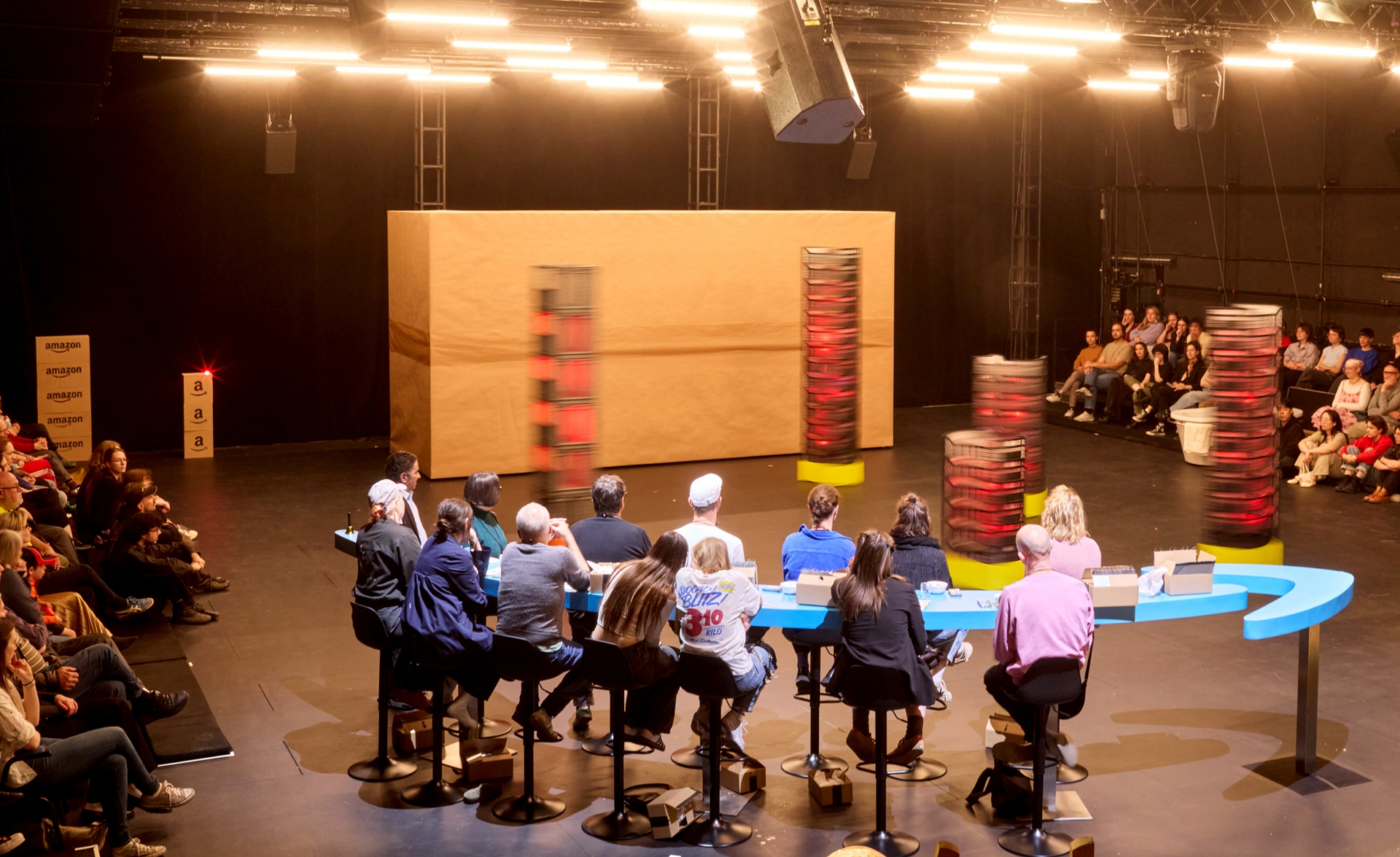
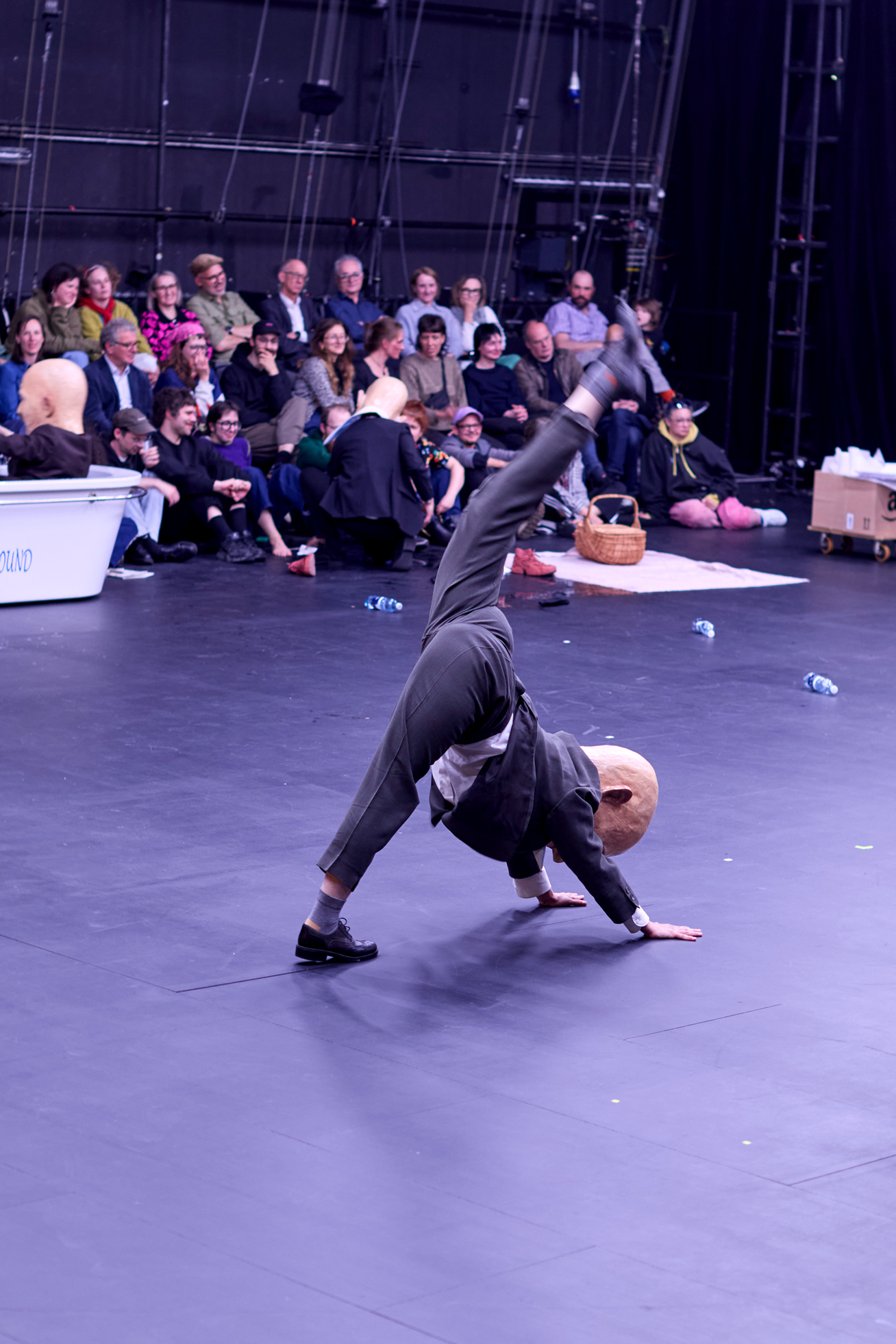
This dynamic begins even before the performance itself, with the selection of a “Prime” audience upon entering. By virtue of an unspecified privilege, this group receives special treatment throughout the show: more stage time, food and drinks, parcels to unbox, and even acts of care such as feet-washing.
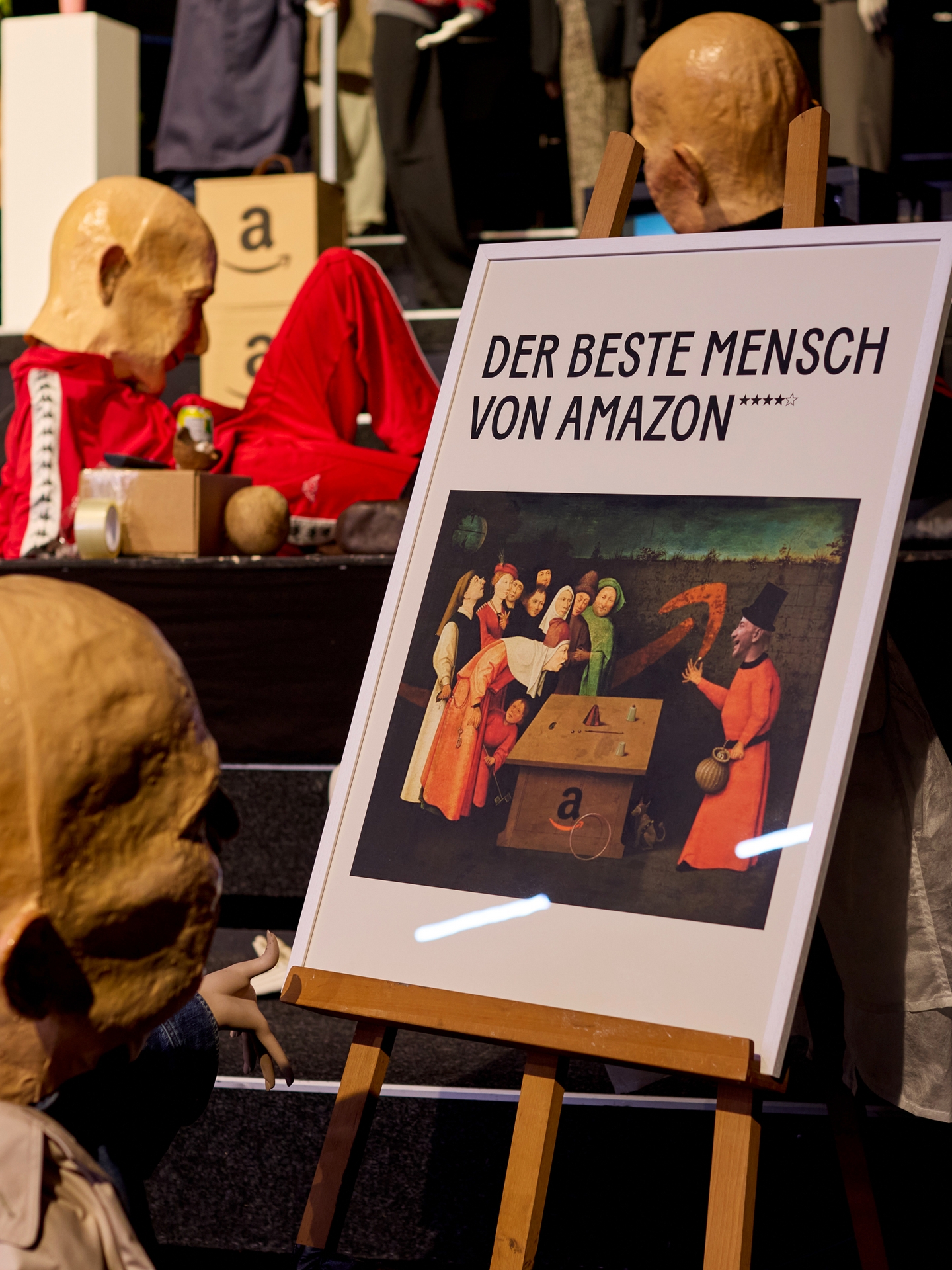
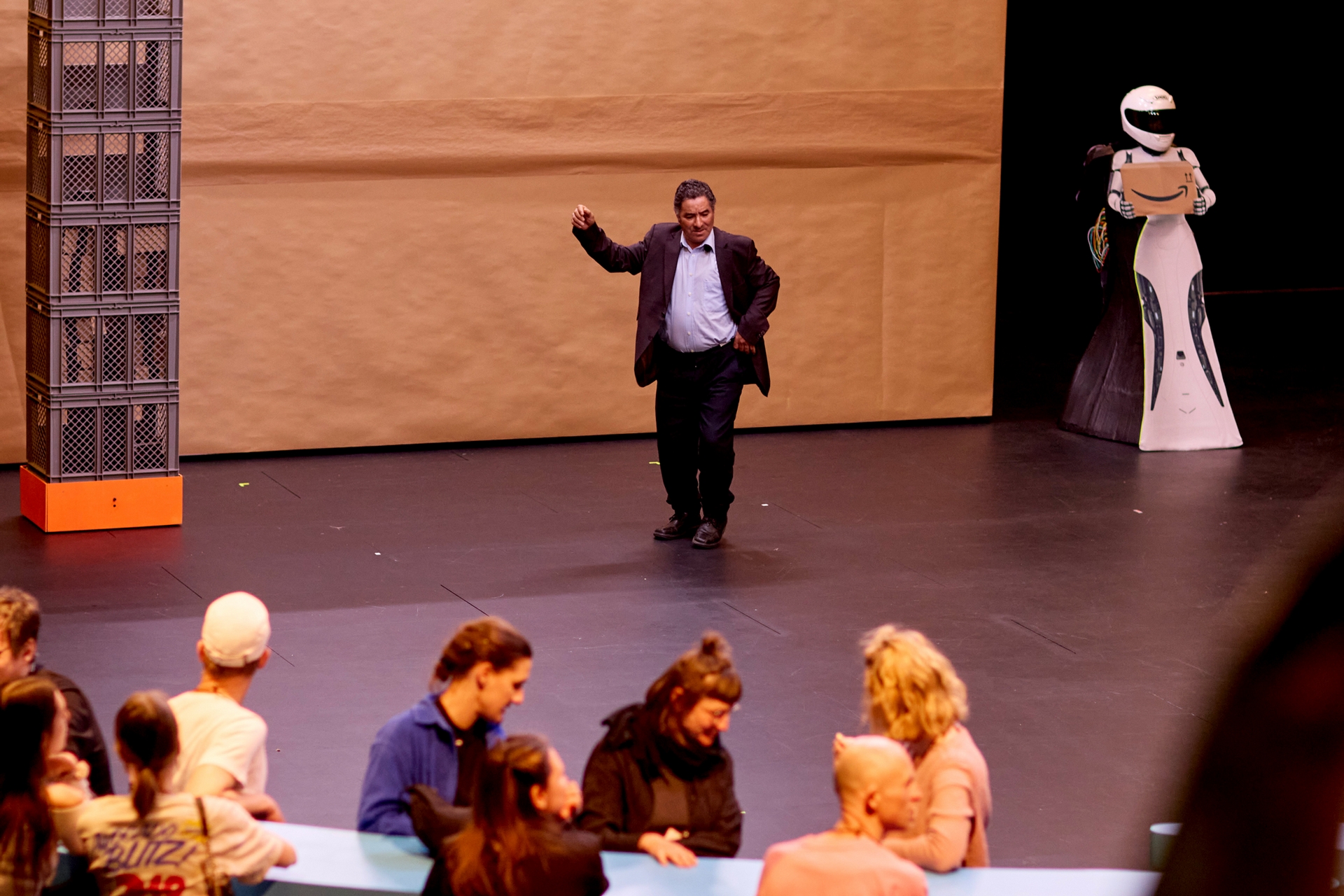
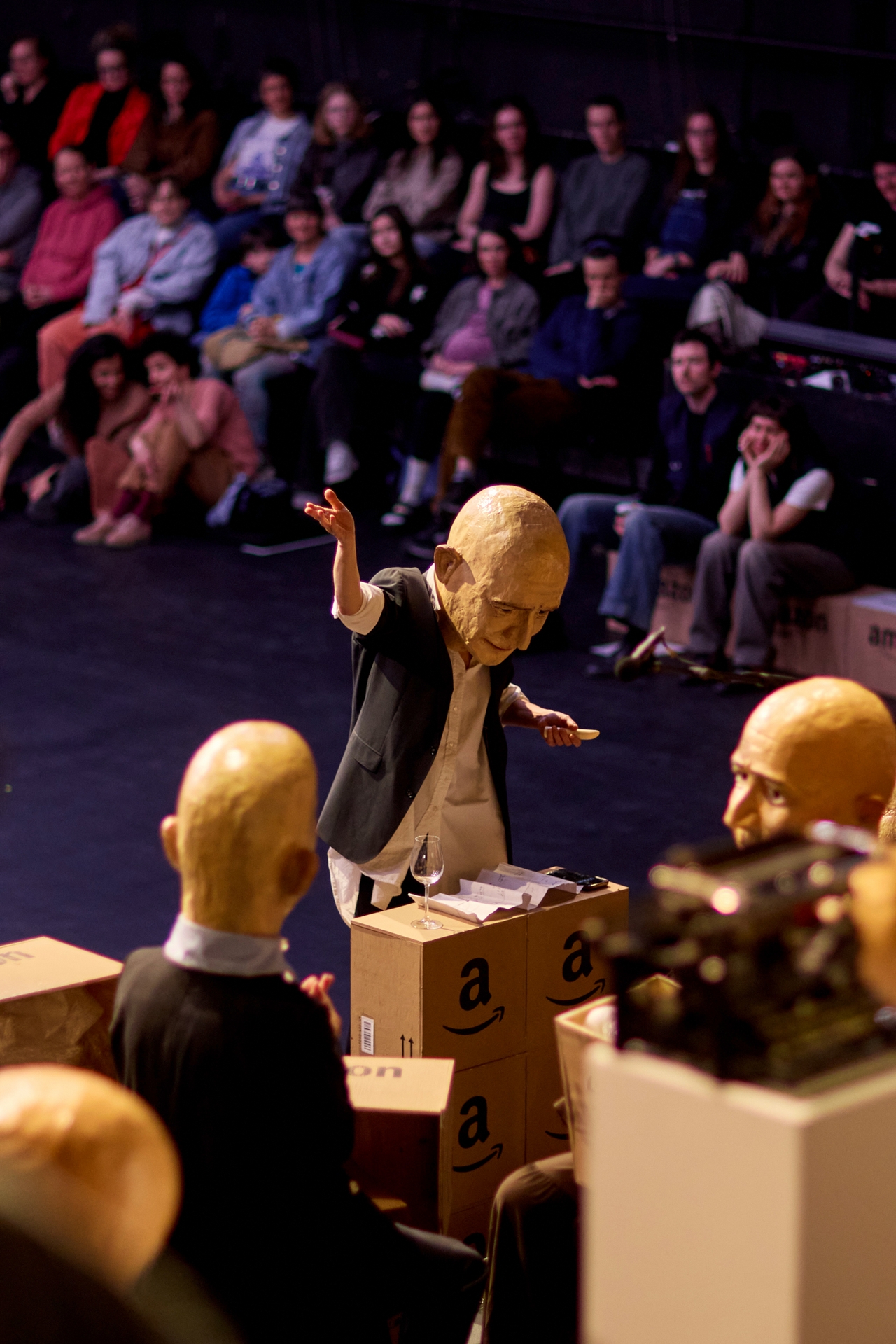
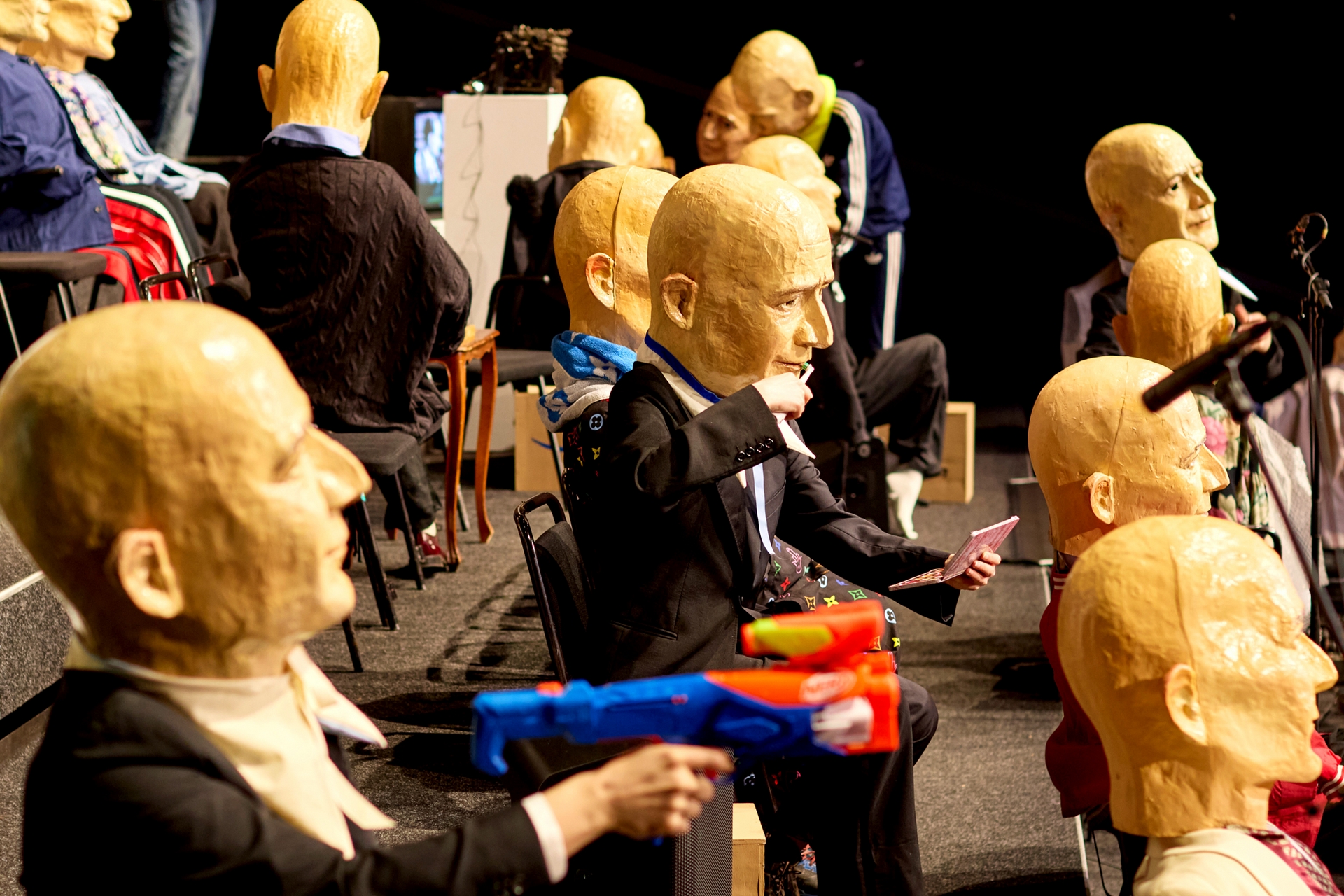
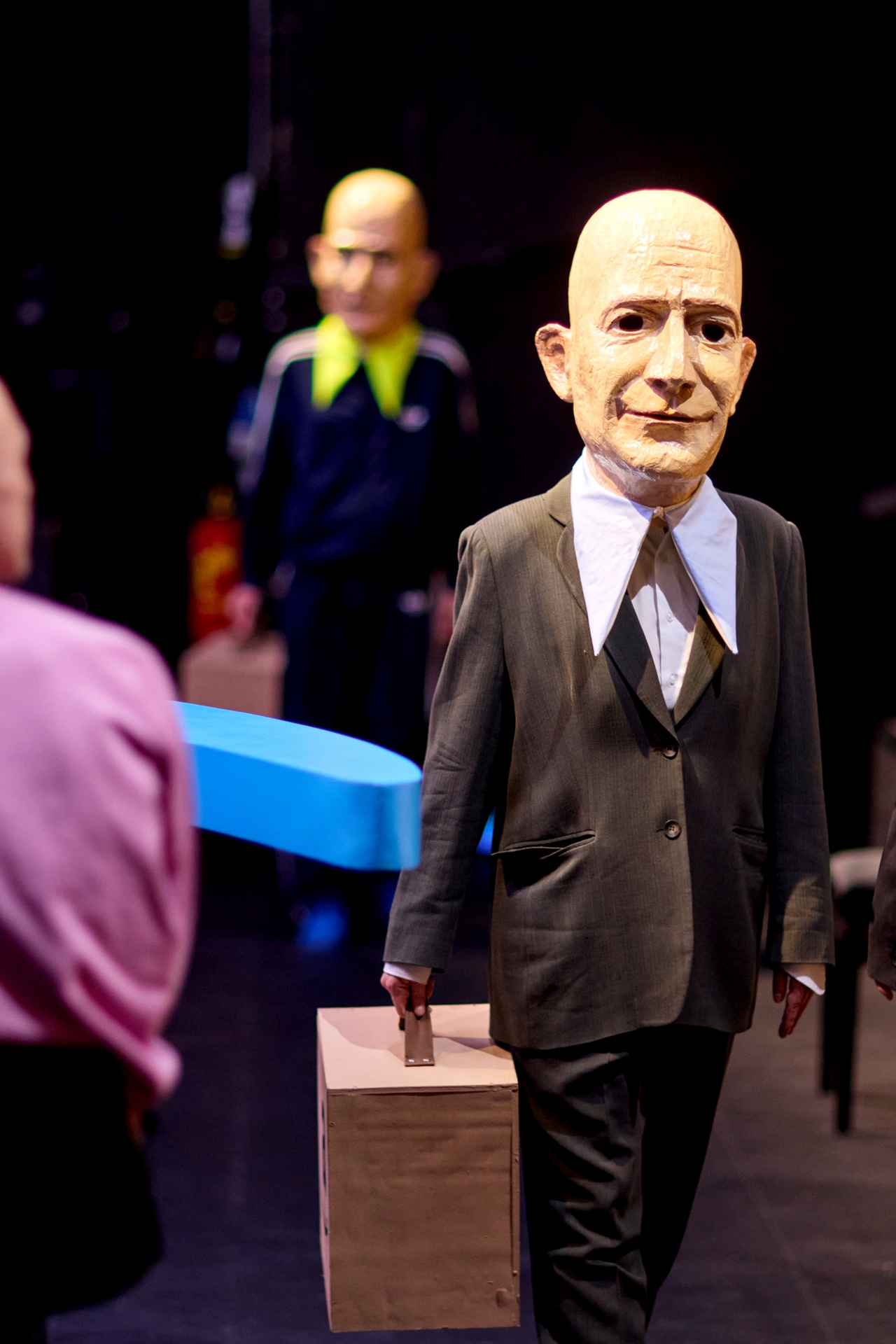
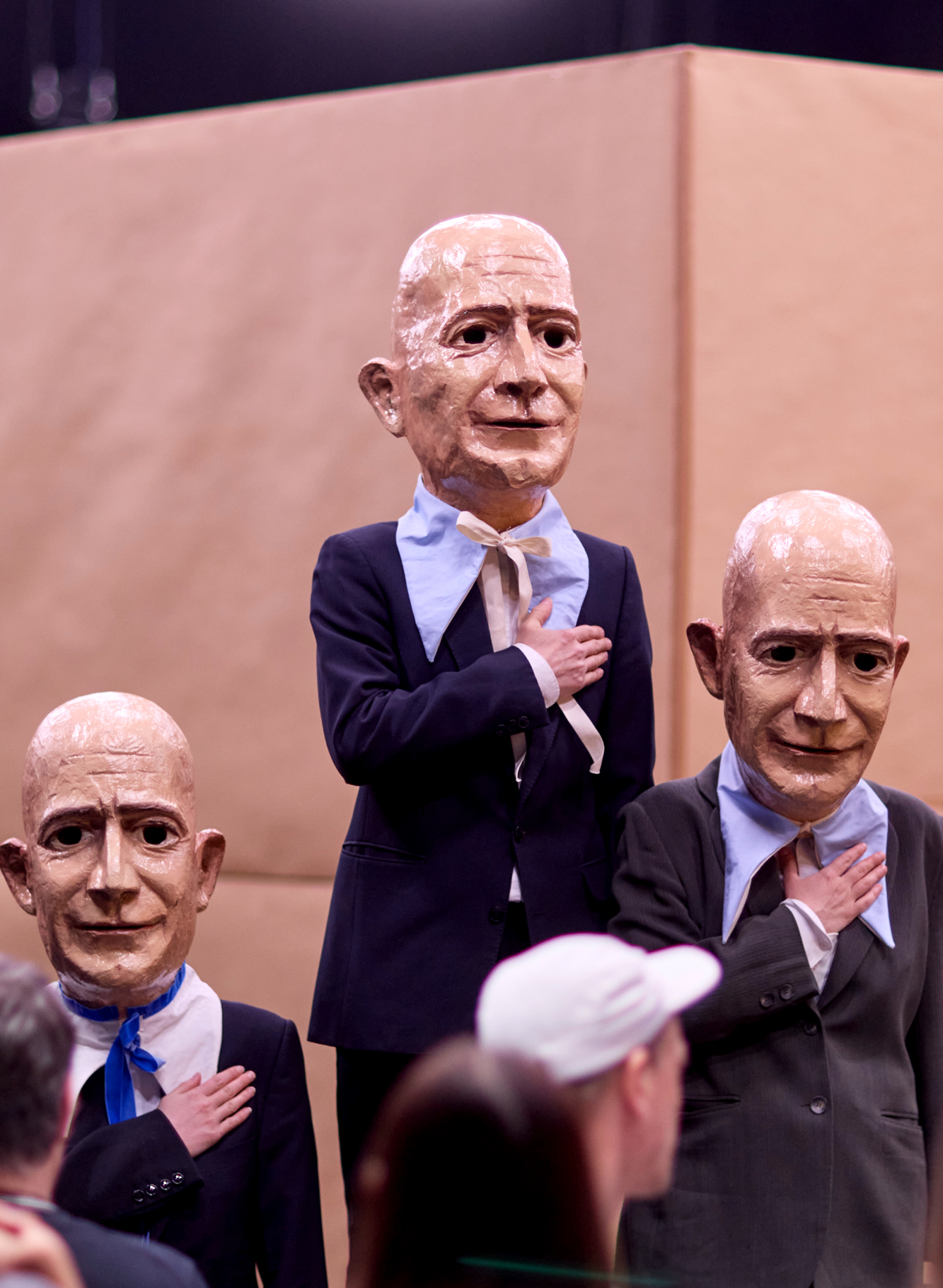
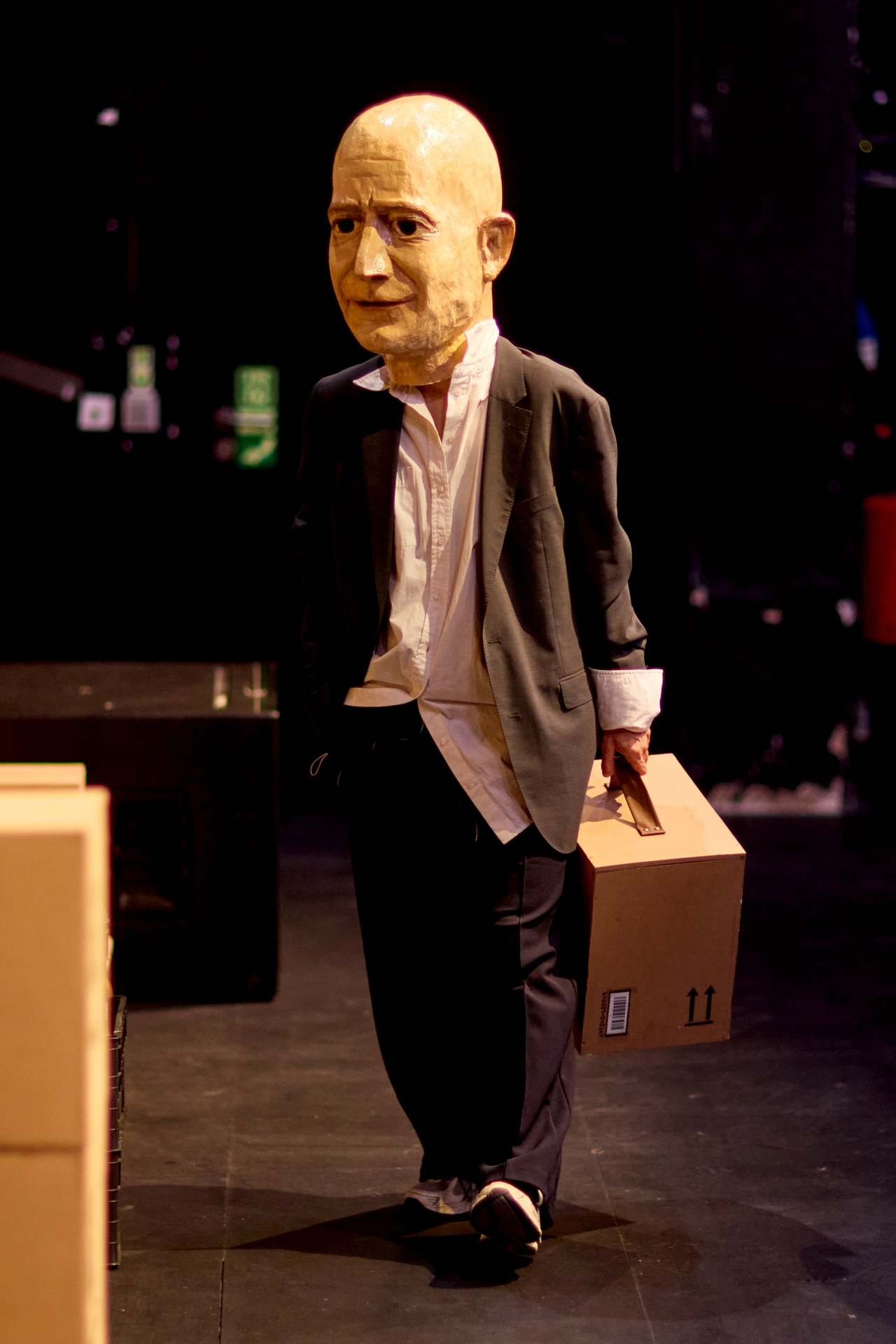
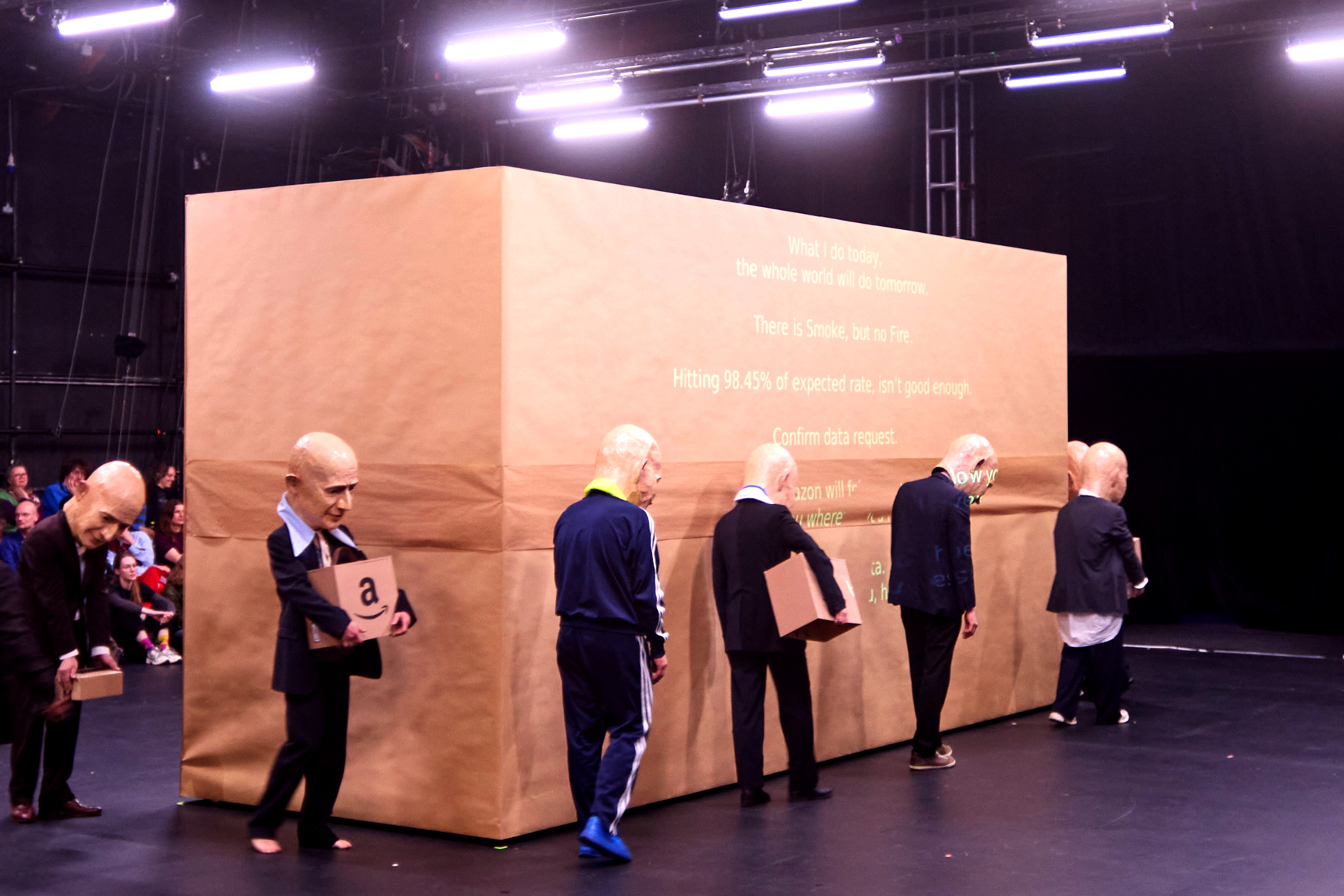
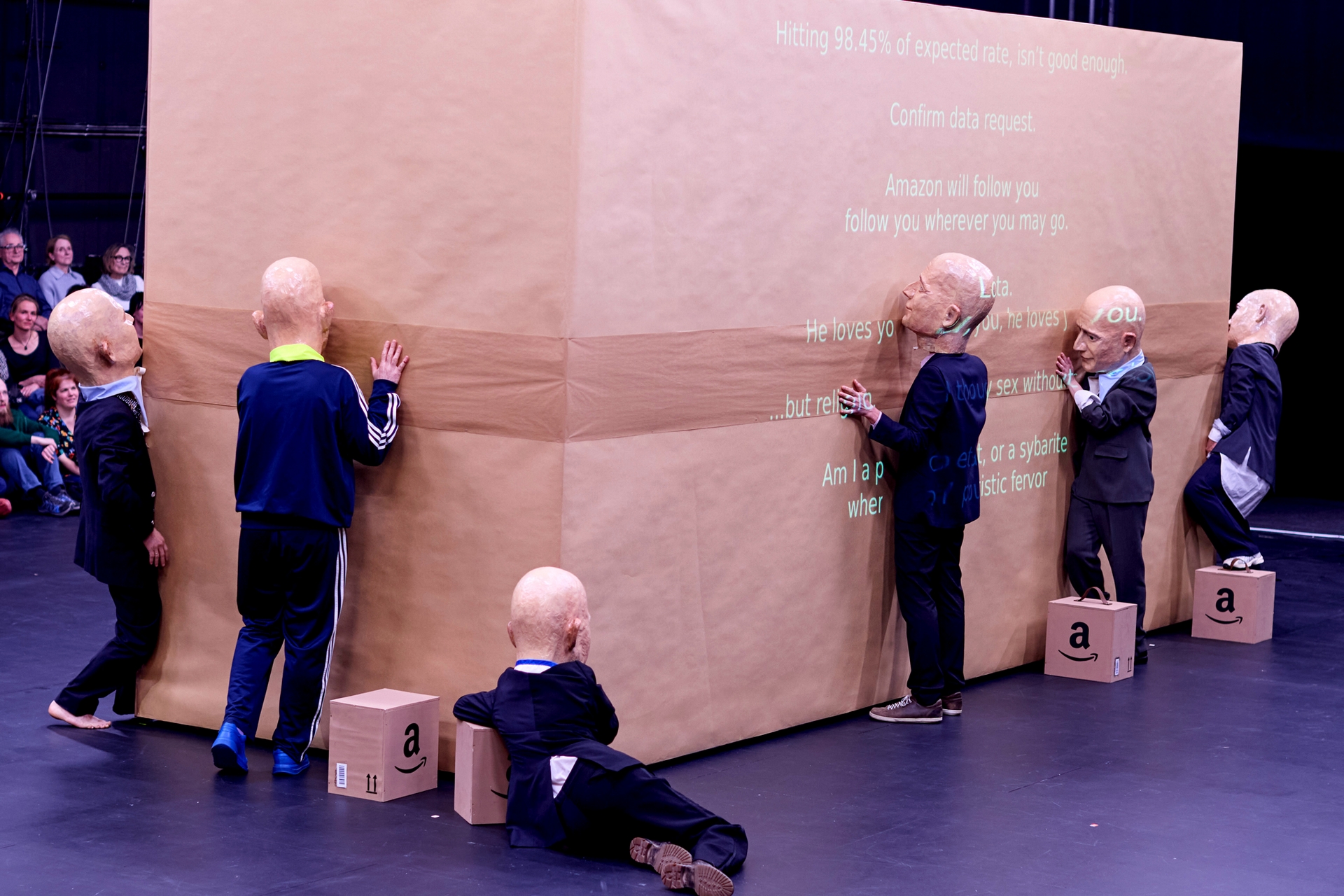
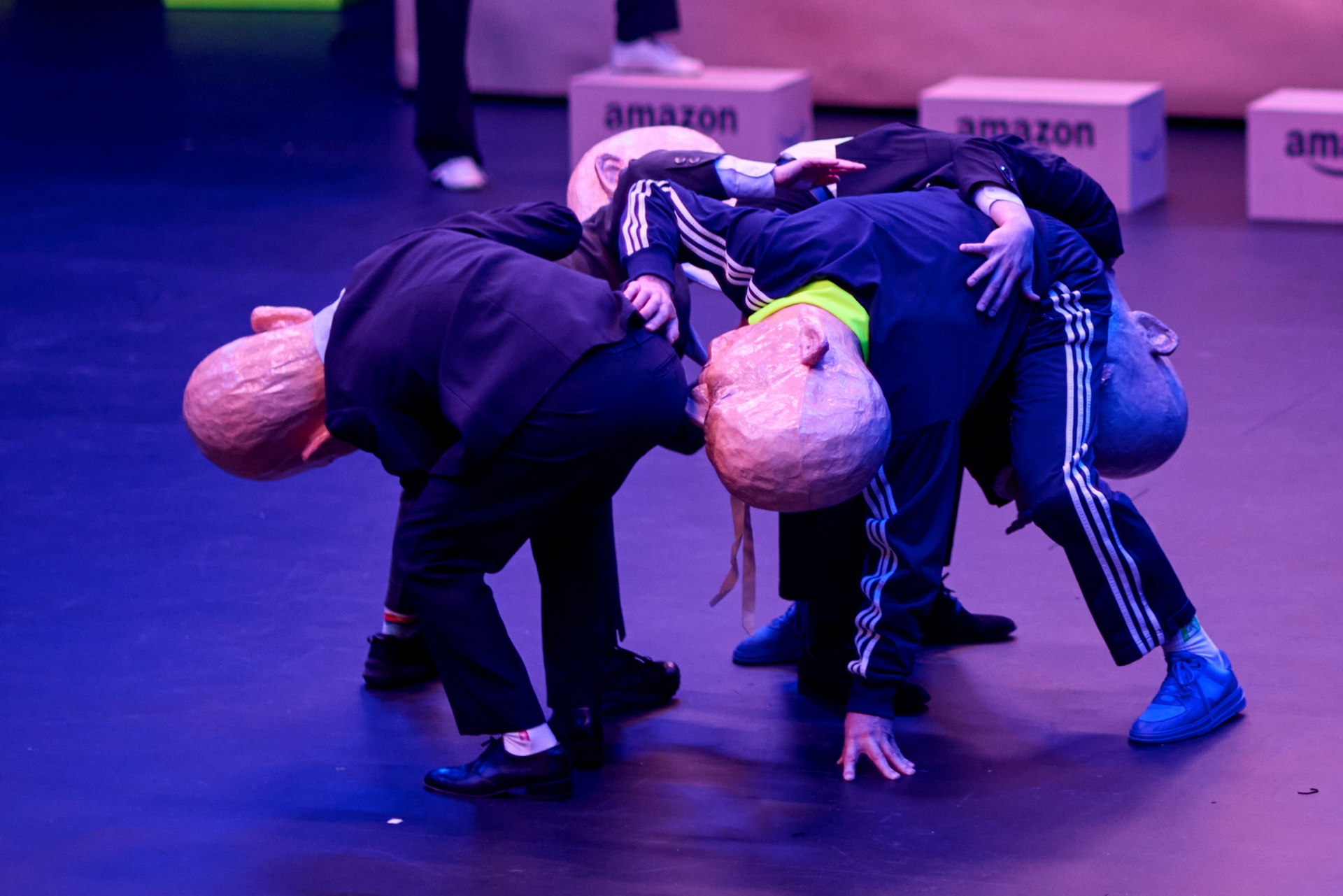
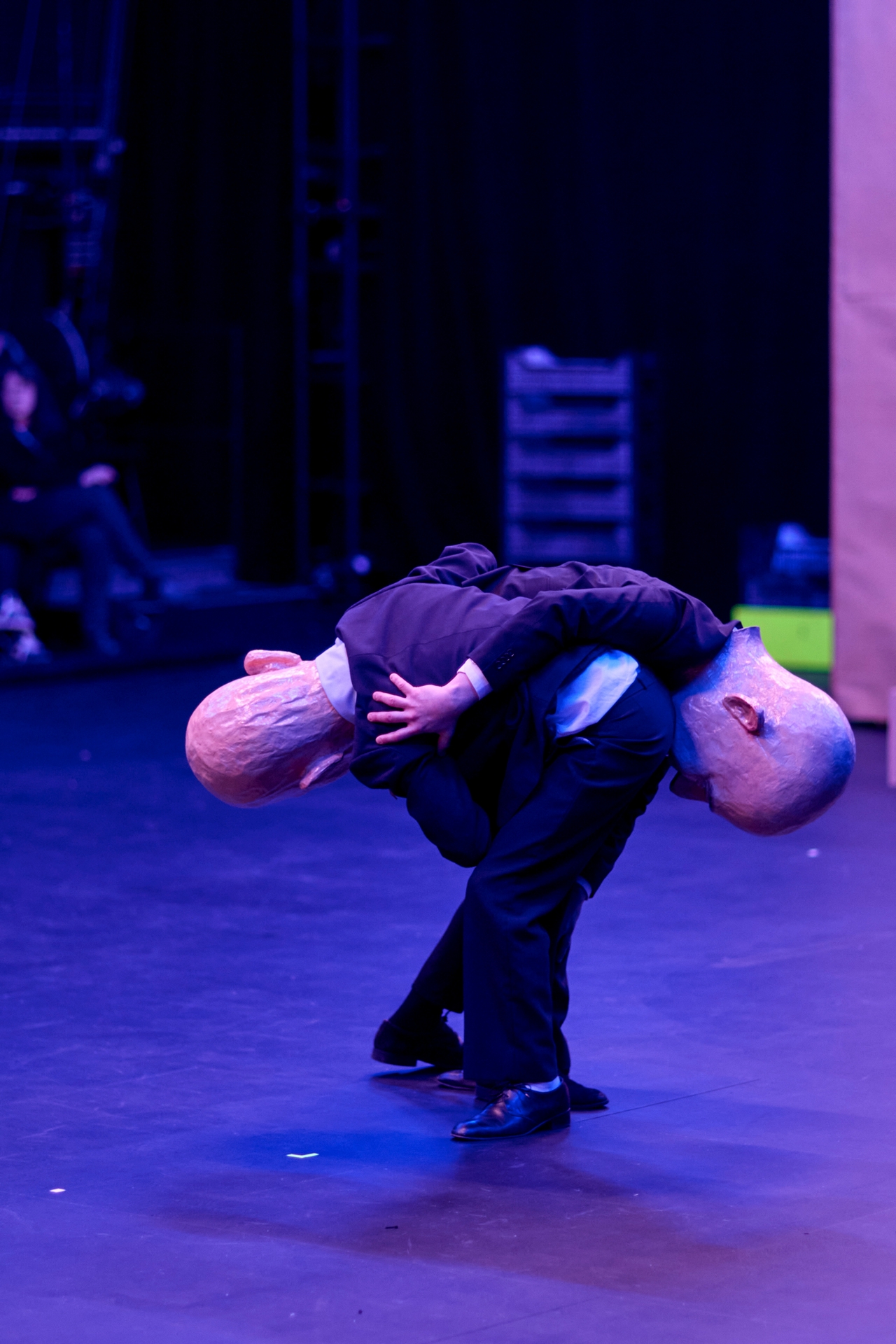
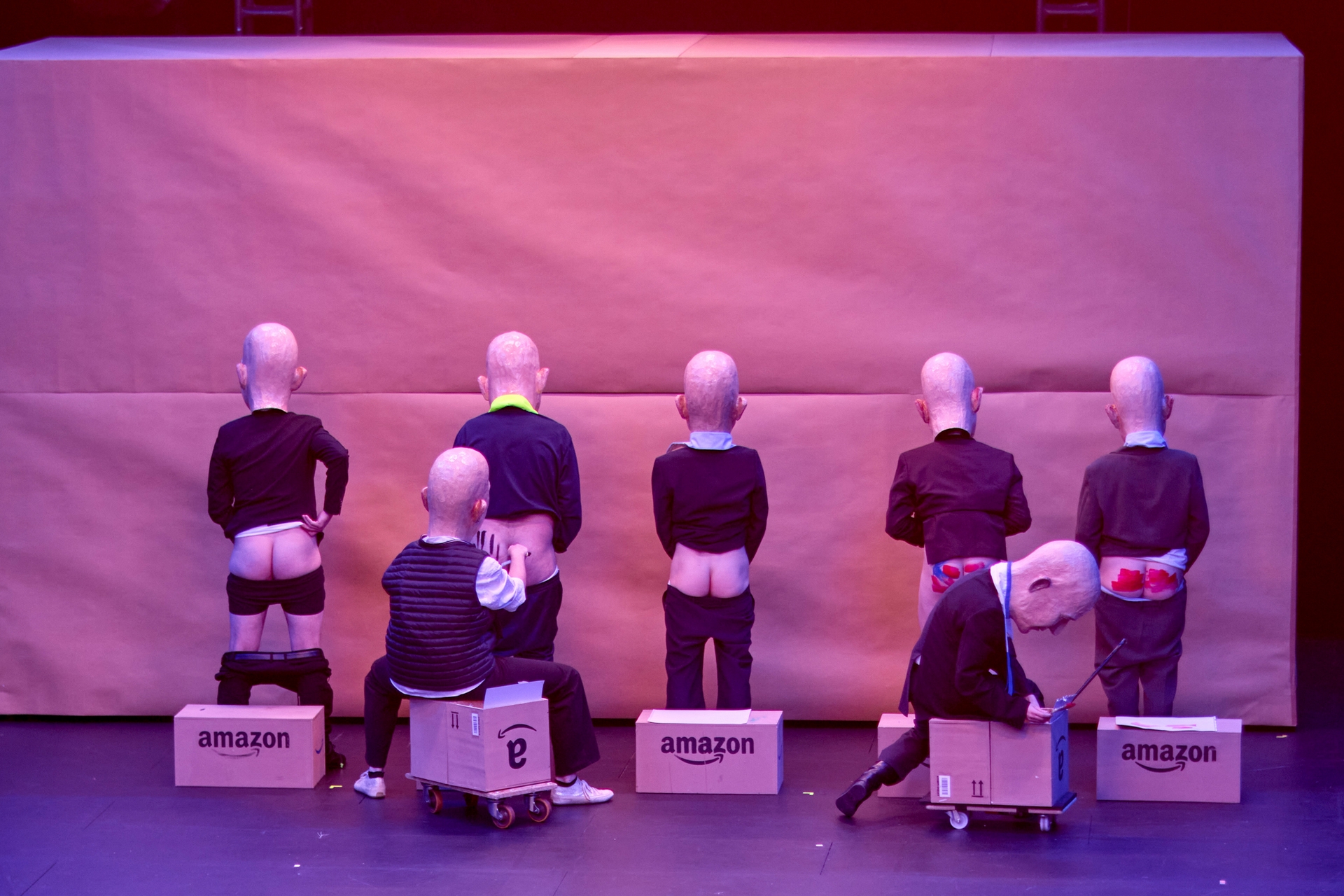
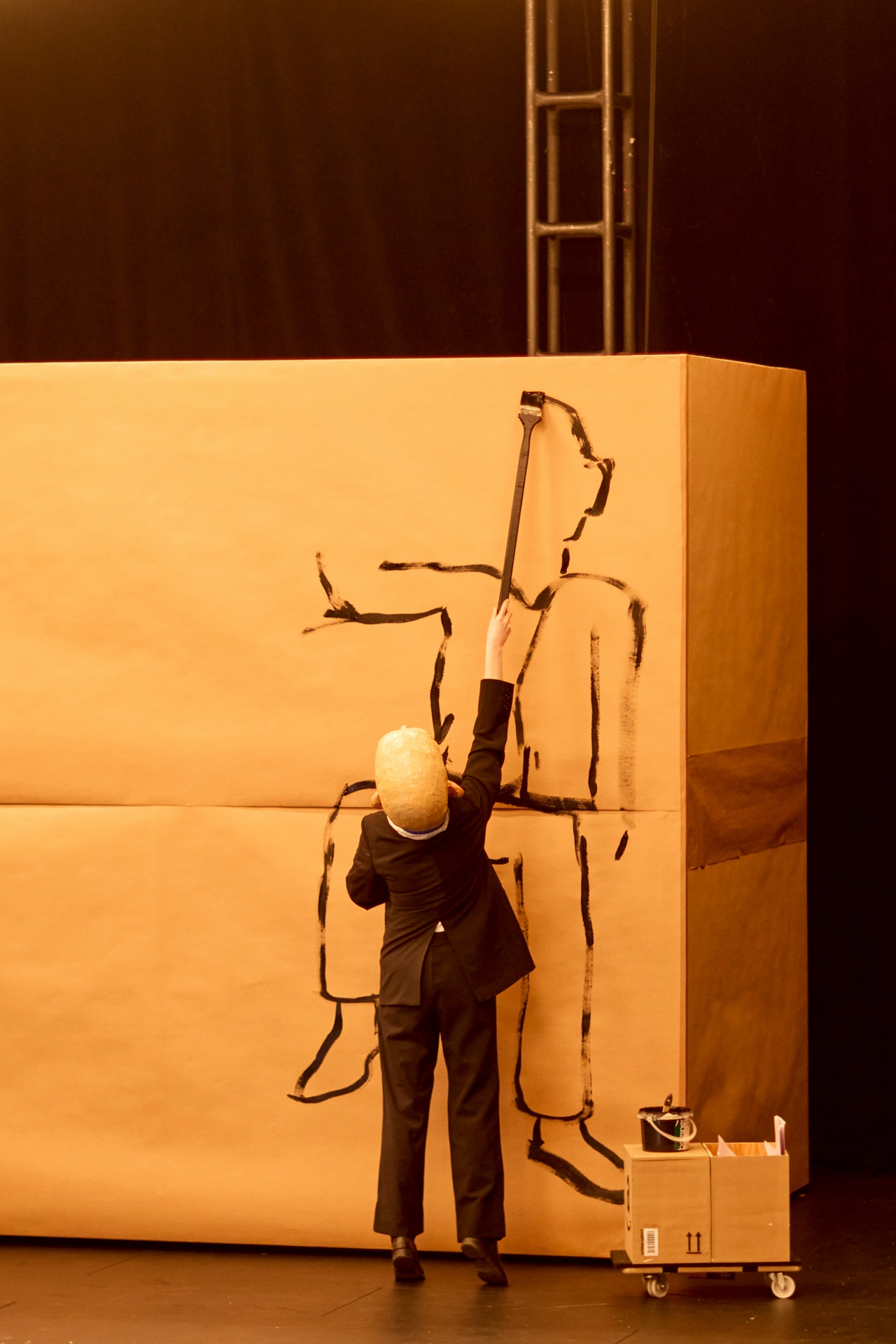
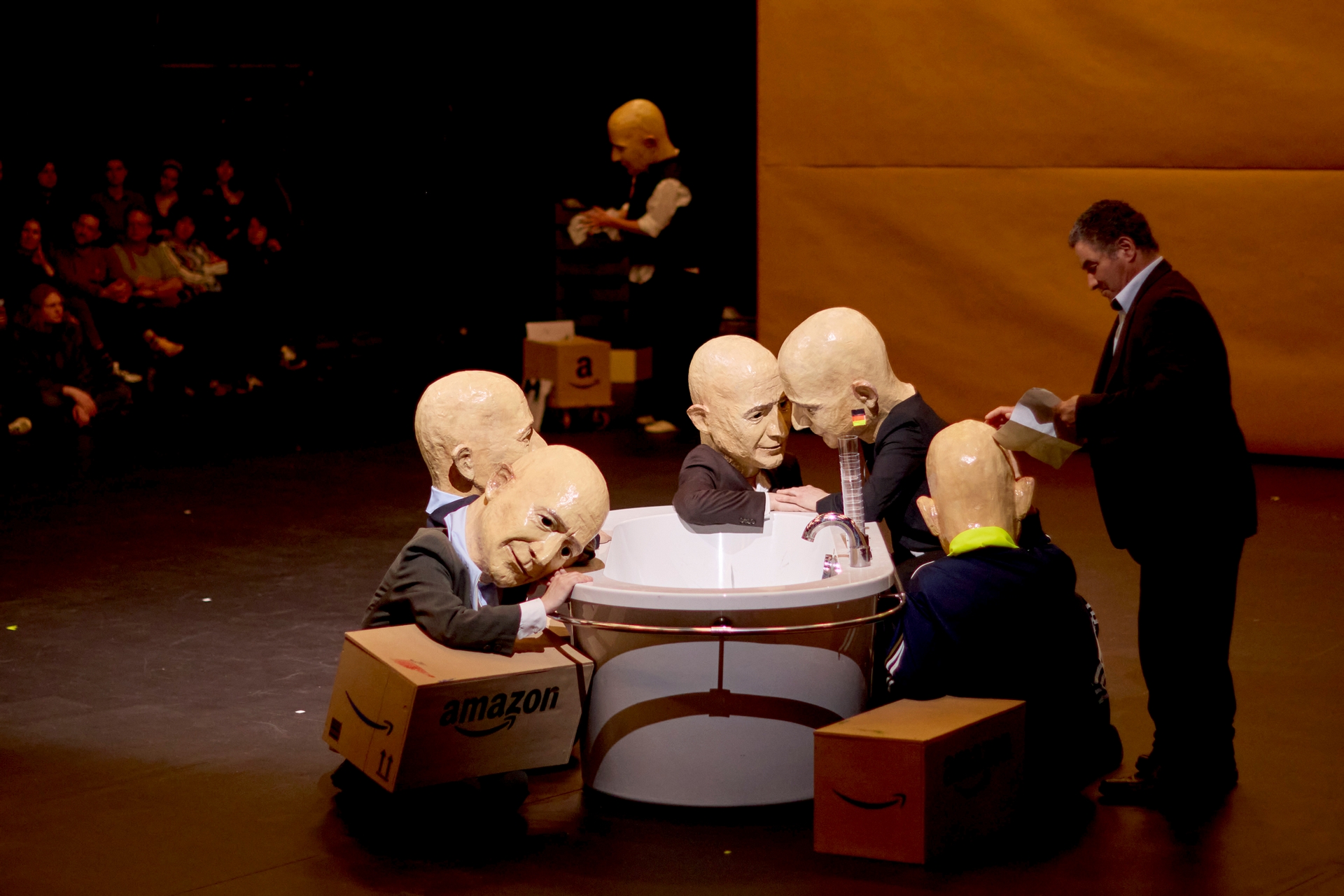
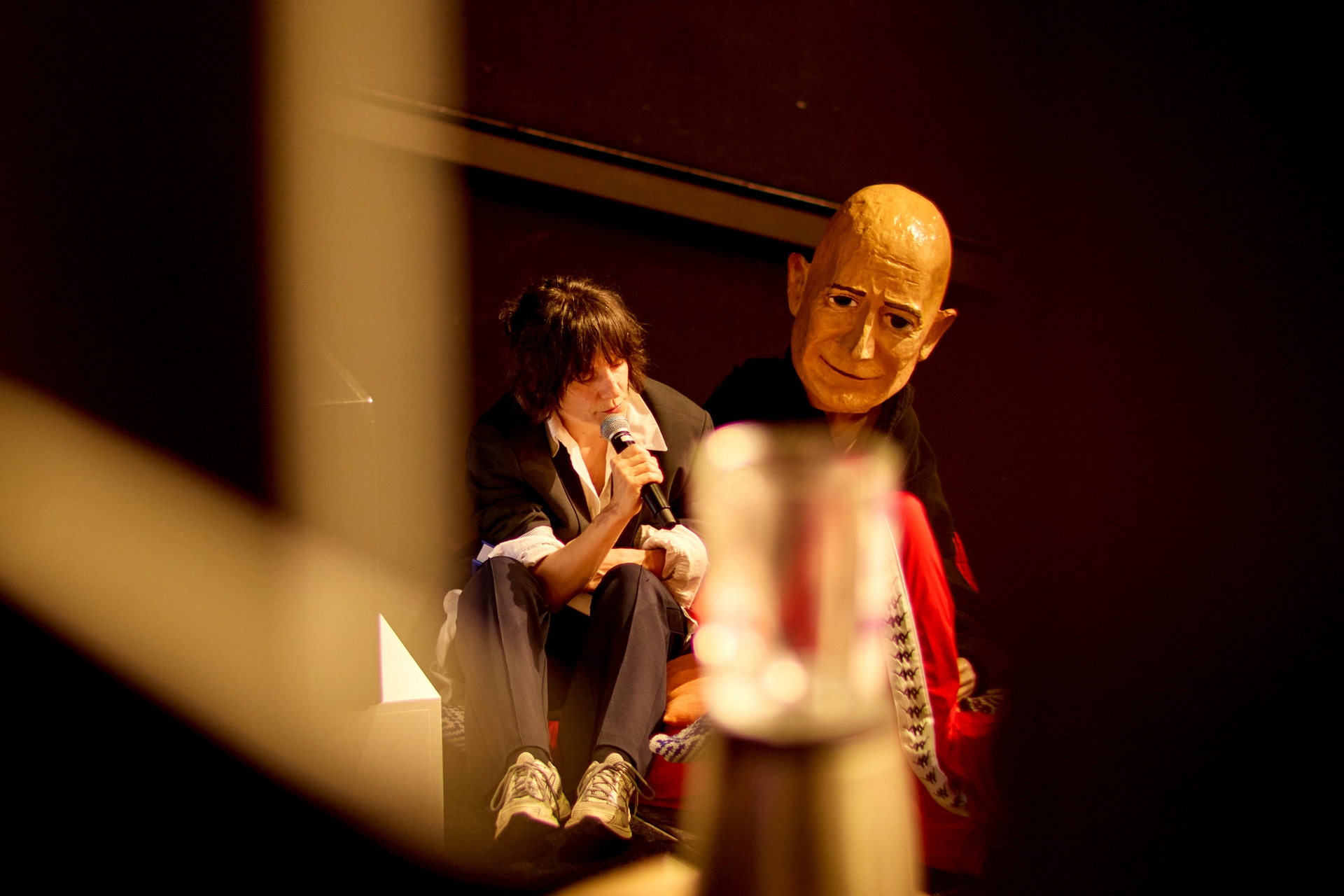
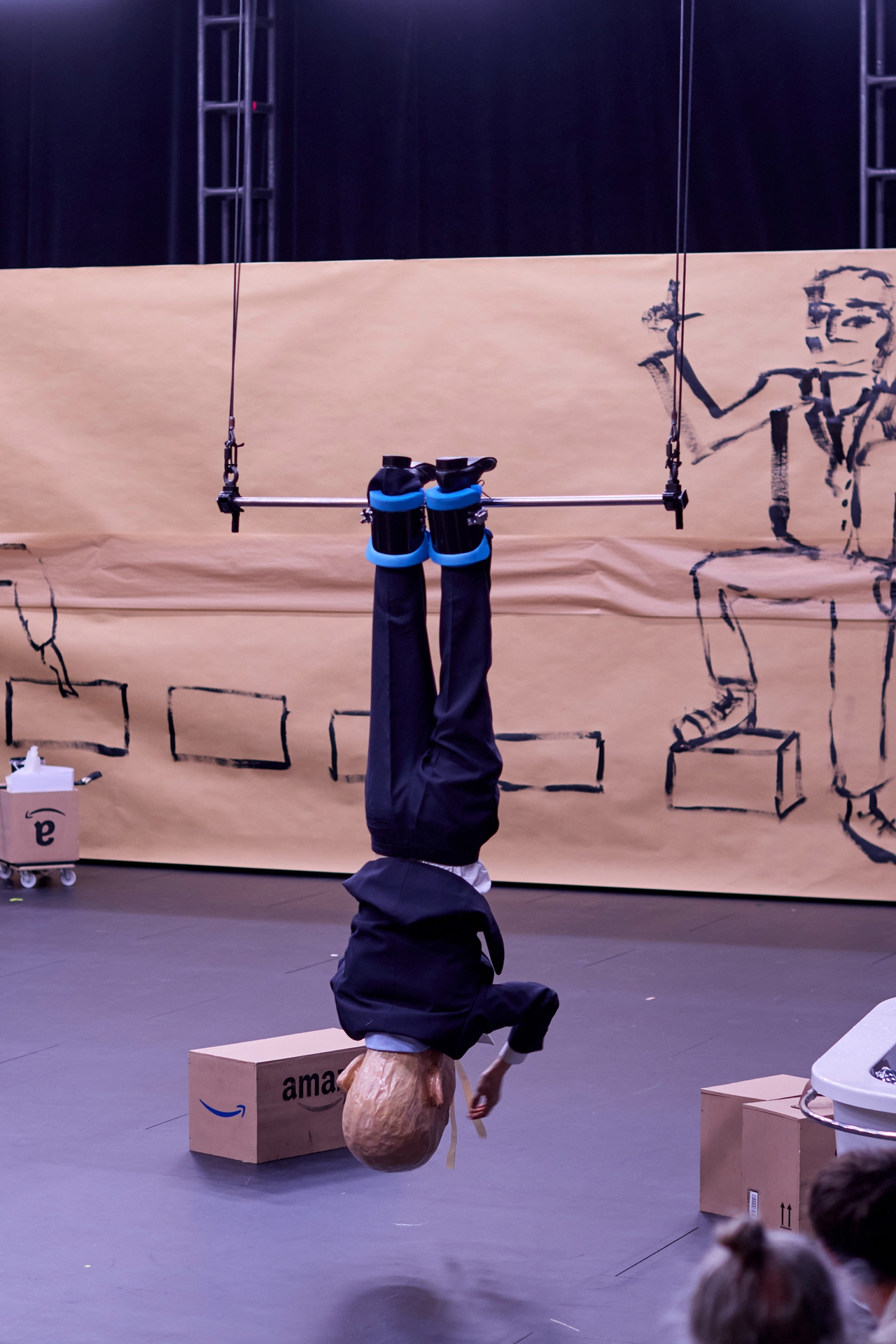
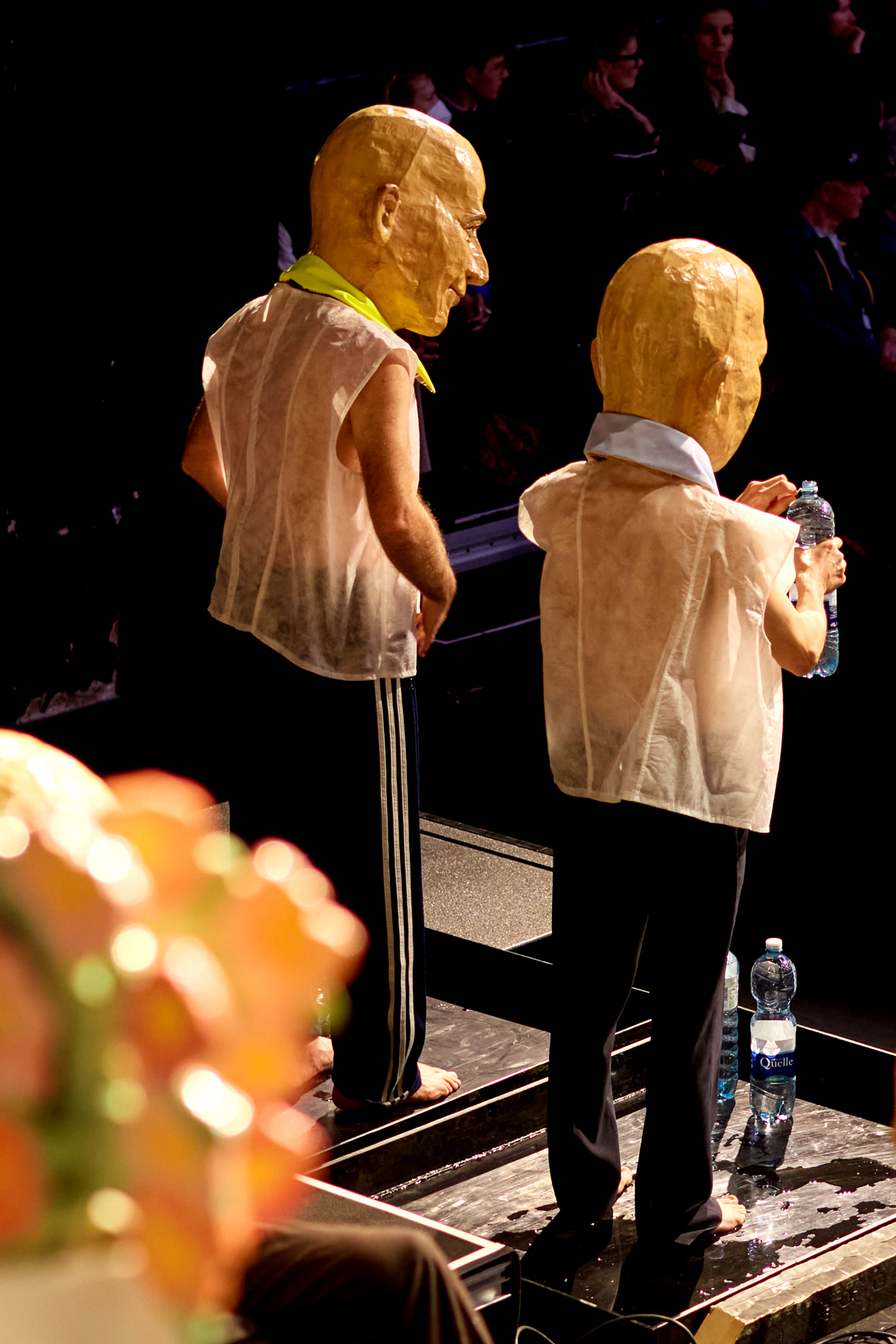
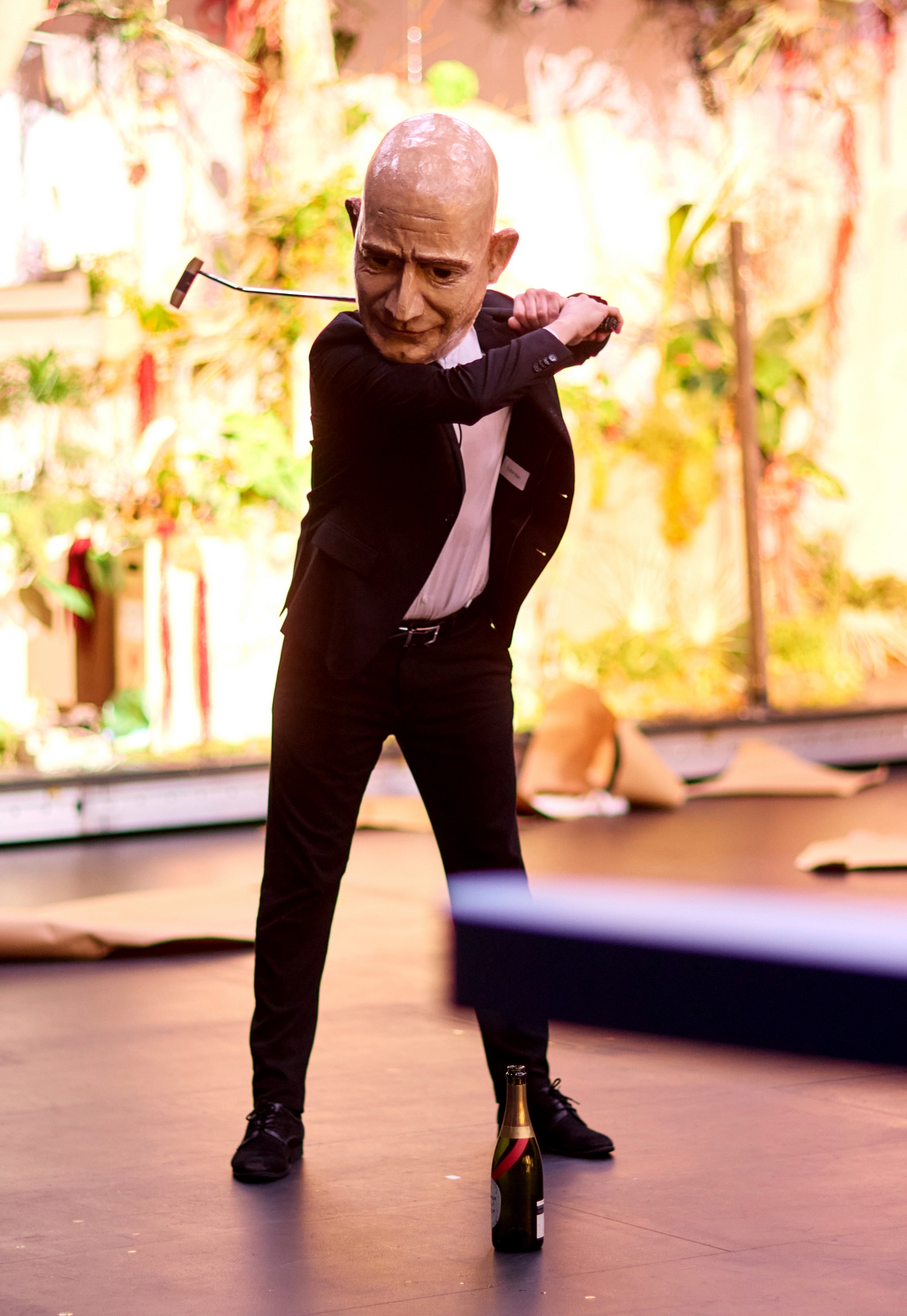
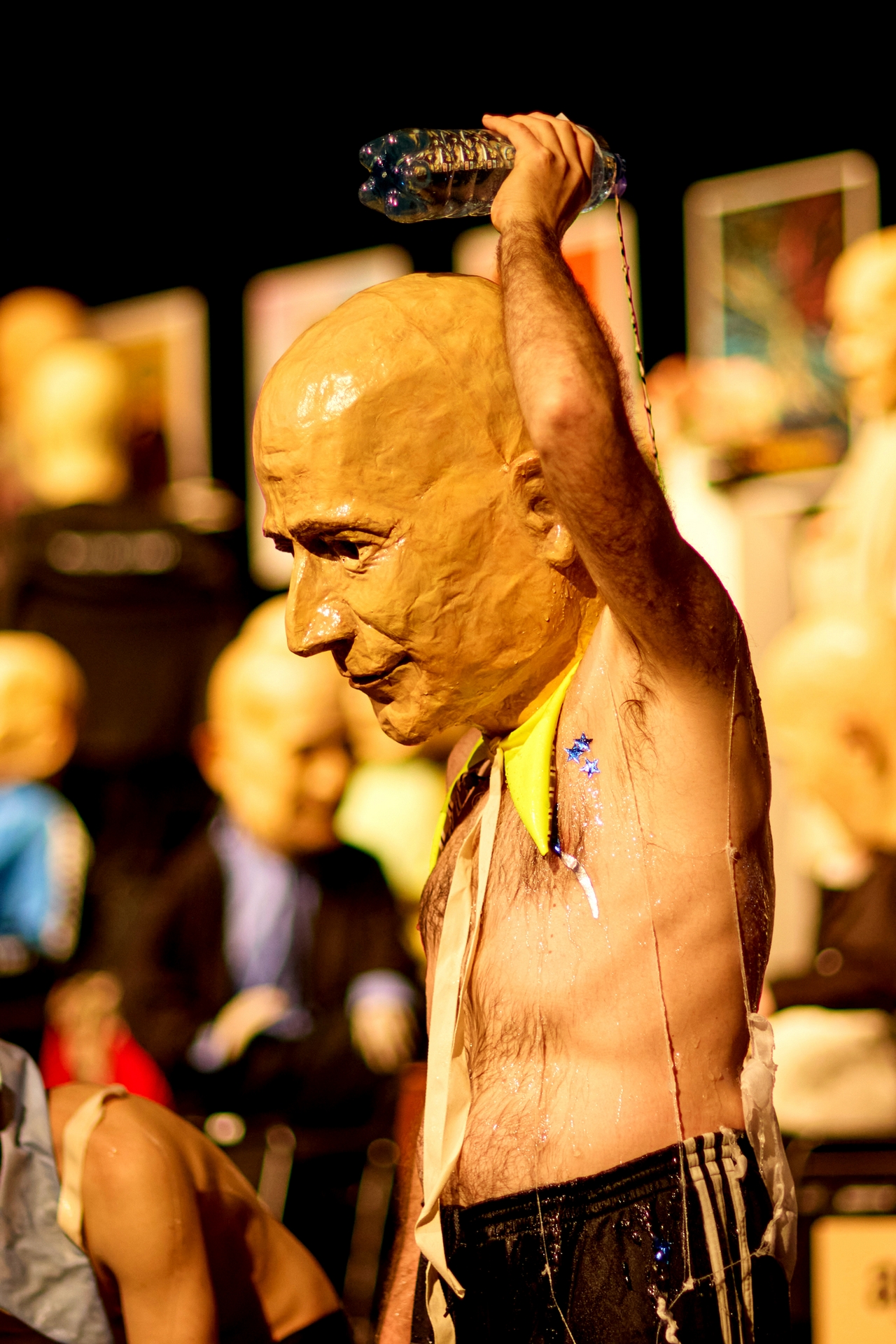
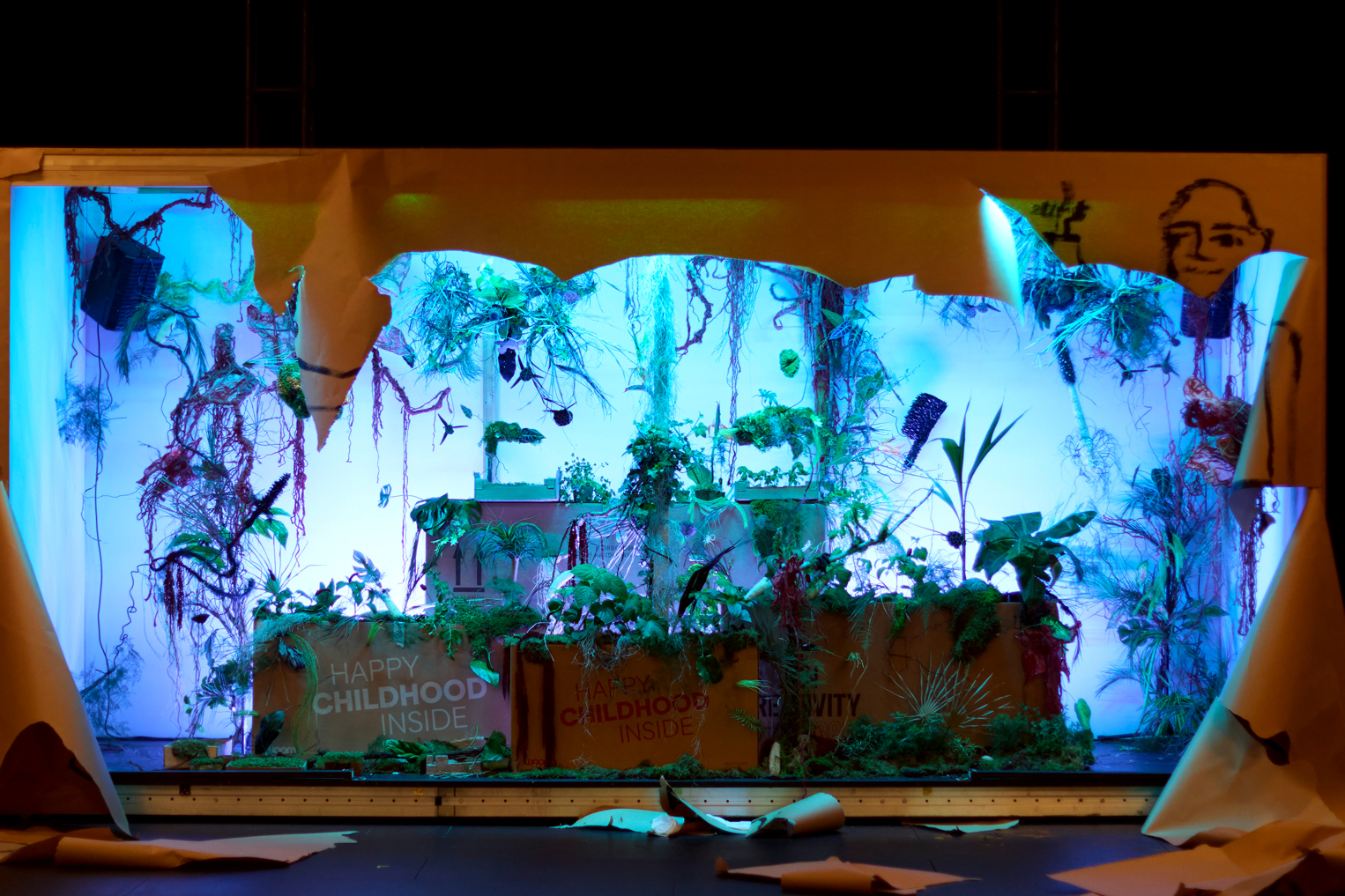
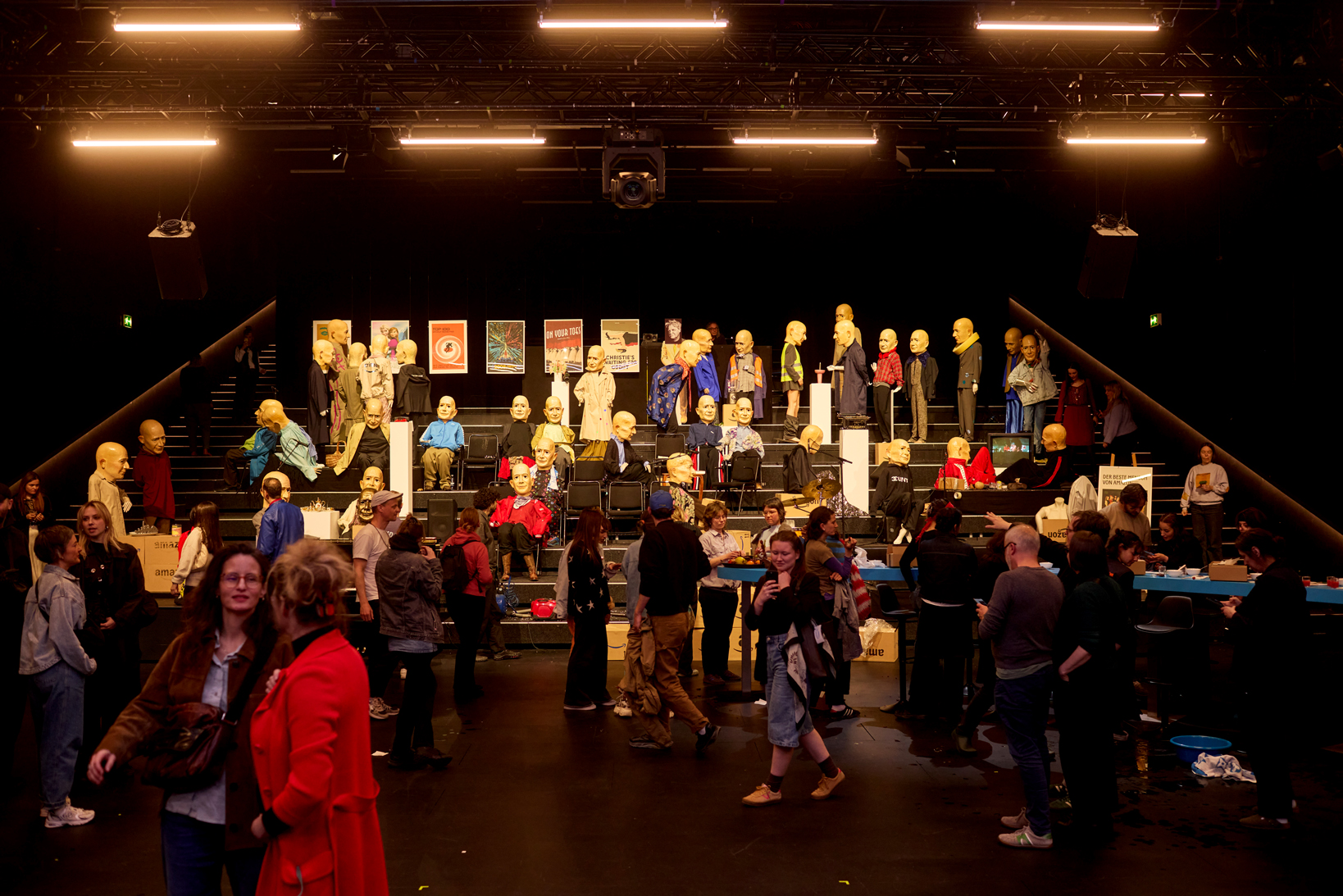
Entering our box for the evening, we are then confronted with a flock of Bezoses in all kinds of attire, each featuring true-to-but-still-larger-than-life papier-mâché heads. A large cardboard box looms at the back of the stage, haunting the performance until its very end. The piece opens in a warehouse setting: robots take over the choreography, moving to classical music, while stacks of plastic crates are humorously granted a ten-minute break. Seemingly playful, the scene points to the documented realities of Amazon warehouses, raising the question of who is allowed leisure within the capitalist grind.
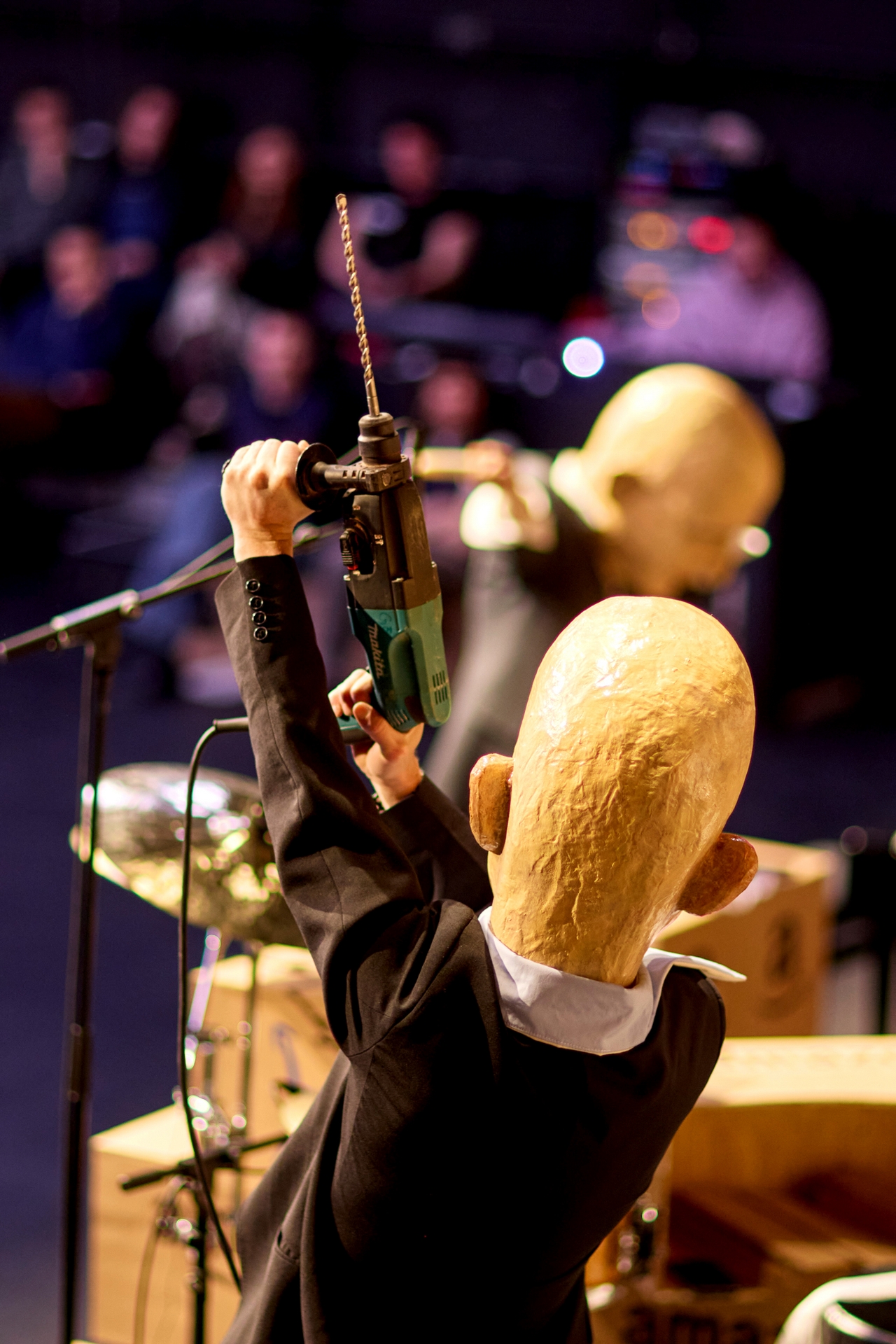
As Bezoses start to come to life, they slowly move into an Amazon symphony, a conducted piece for an orchestra composed of different Amazon-available products such as juicers and drills, with a special vibrator solo act. We can see that there is a system being made following instructions of use (literally used as a score). What emerges is a tight constellation of goods and content—a self-contained “box-world” with its own rules, hierarchies, and logic. Within it, Bezos effectively crowns himself ruler. After all, how could he not be the best in a world of his own creation?
Gradually, the performance begins to shift and multiply, almost kaleidoscopically, as Gods start unpacking (pun intended) the references they have set up. A few striking images stand out: a human hand drowning under a flood of boxes, reminding us that there is always a person behind—or buried beneath—each Amazon parcel; human bodies used as stamps for the Amazon logo, pushing the commodification of the body to an absurd extreme; or The Man Who Sold the World playing from one of the Bezos heads. As usually in their case, Gods are in the details.
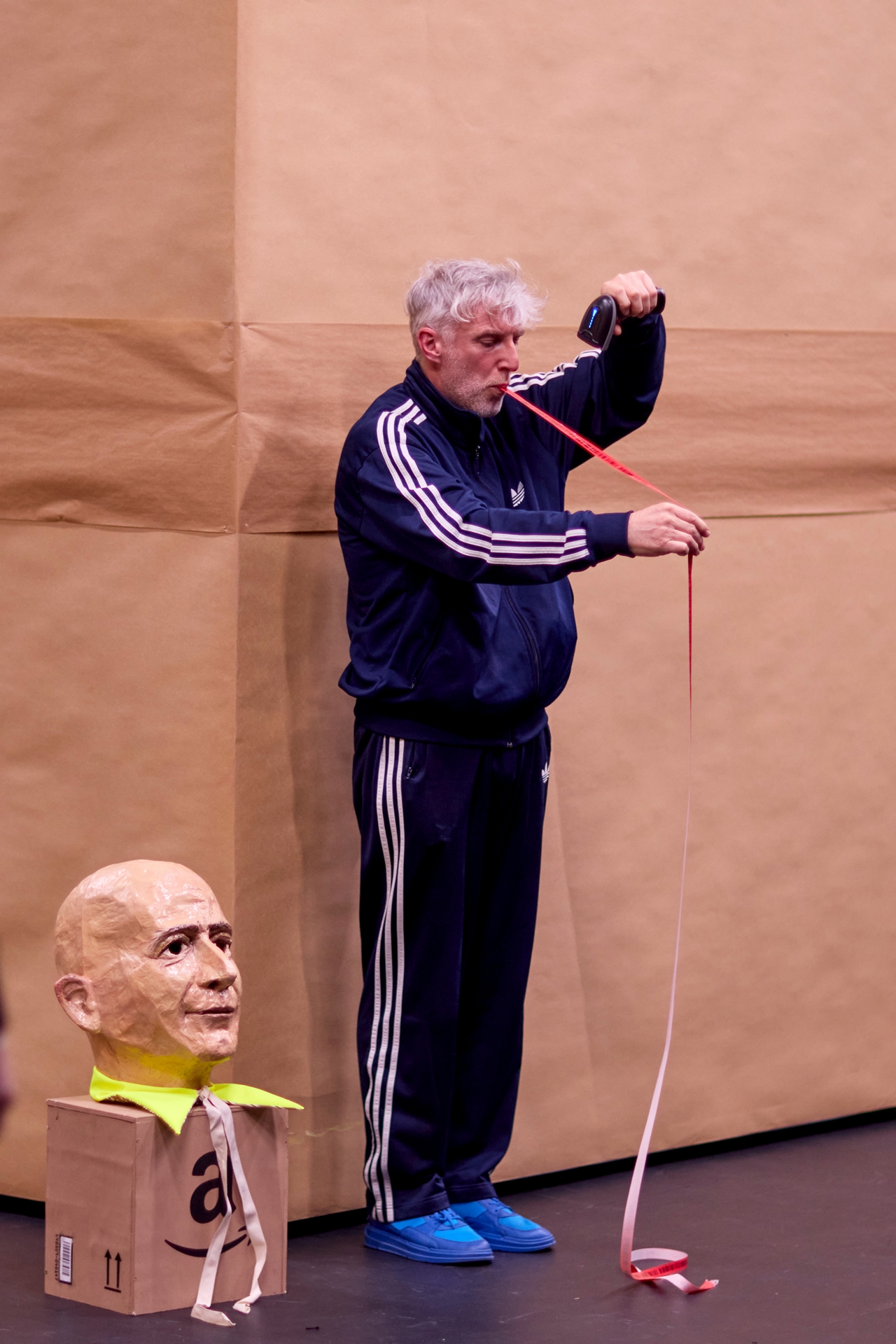
At one point, a now headless Bezos pulls a long barcode scroll from his mouth and scans this newly formed “tongue,” projecting a poem by Kevin Killian onto the large box. During several years and with a clear intent to subvert the logic of this capitalist language, Killian placed more than 2000 Amazon “reviews” totally unusable to the general logic of its commercial goal as they were poetic fragments, autobiographical snippets, etc. Building on this great material and the overall gesture of subversion, the performance detects the dangers of the review-lingo that penetrates our bodies and makes us speak the logic of capitalism.
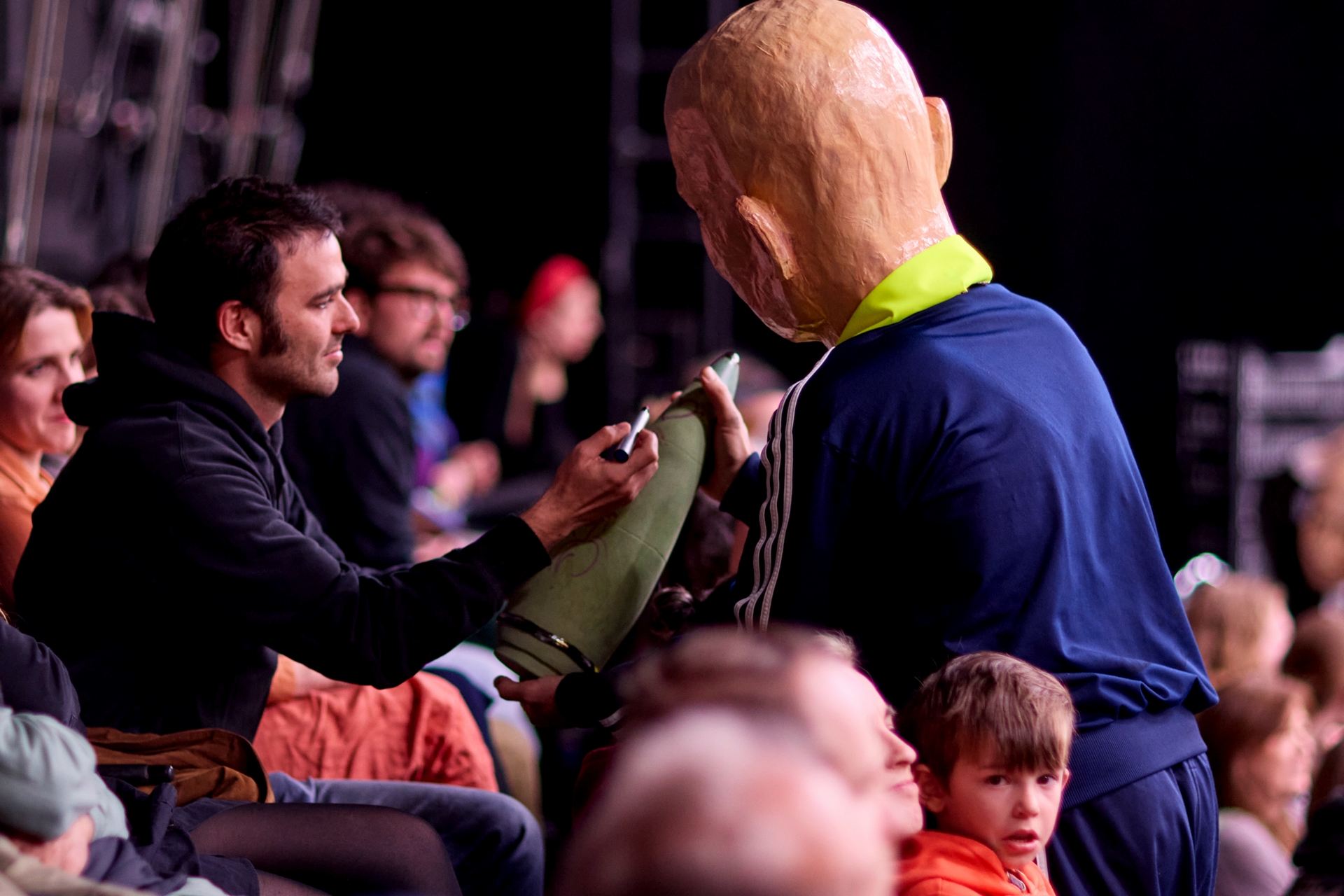
Amid a surge of chaotic action depicting Bezoses well-known obsession with living forever, Forever Young by Alphaville blares—a song that famously blends the fear of nuclear catastrophe with the desire for eternal youth. In this context, its lyrics “are you gonna drop the bomb or not?” land differently. As a grenade is passed through the audience for signatures, the performance cuts straight to the core of our present. Dare we close our eyes when faced with our own responsibility in supporting Amazon’s involvement in wider systems of conflict? What does our mouse-click actually trigger?
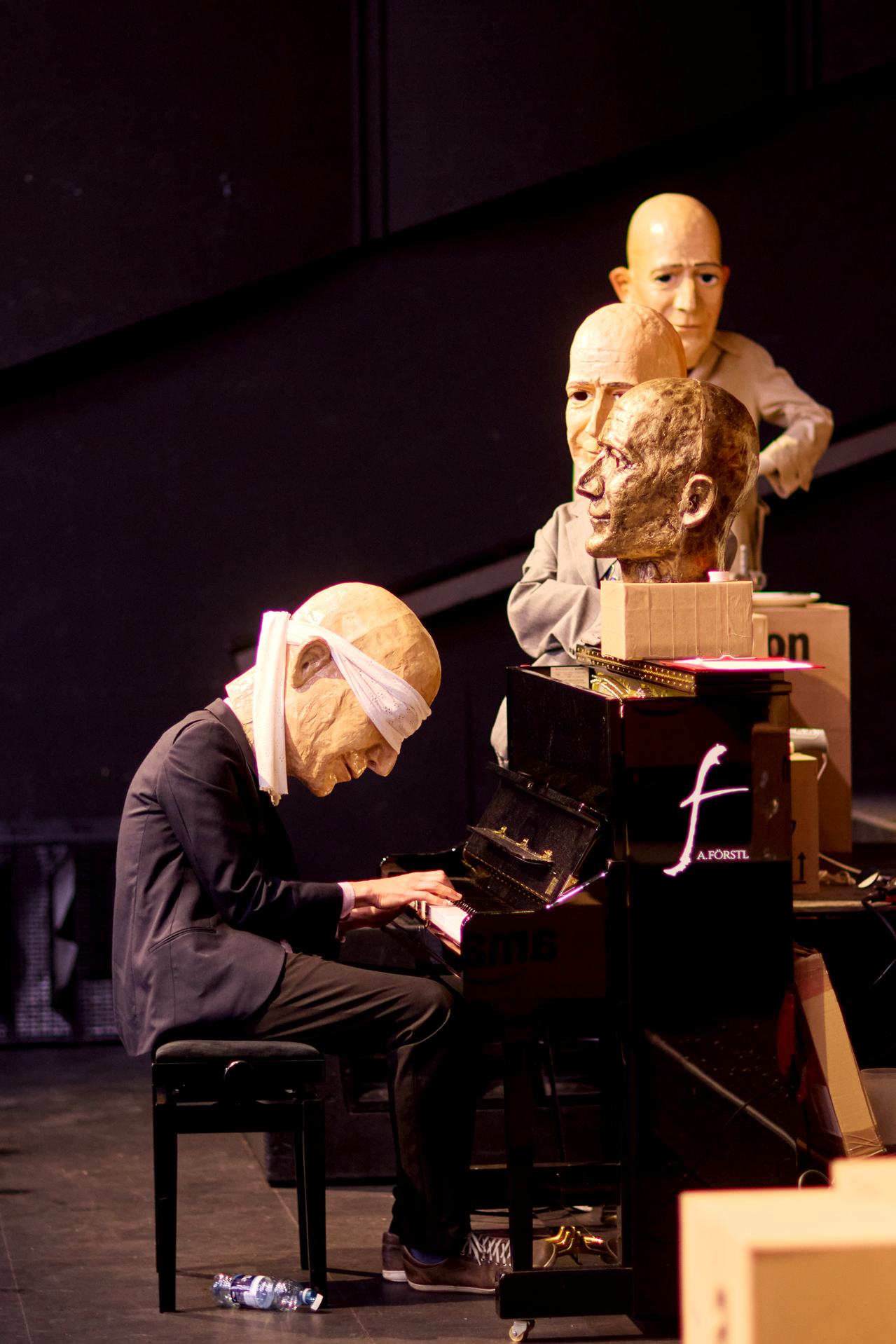
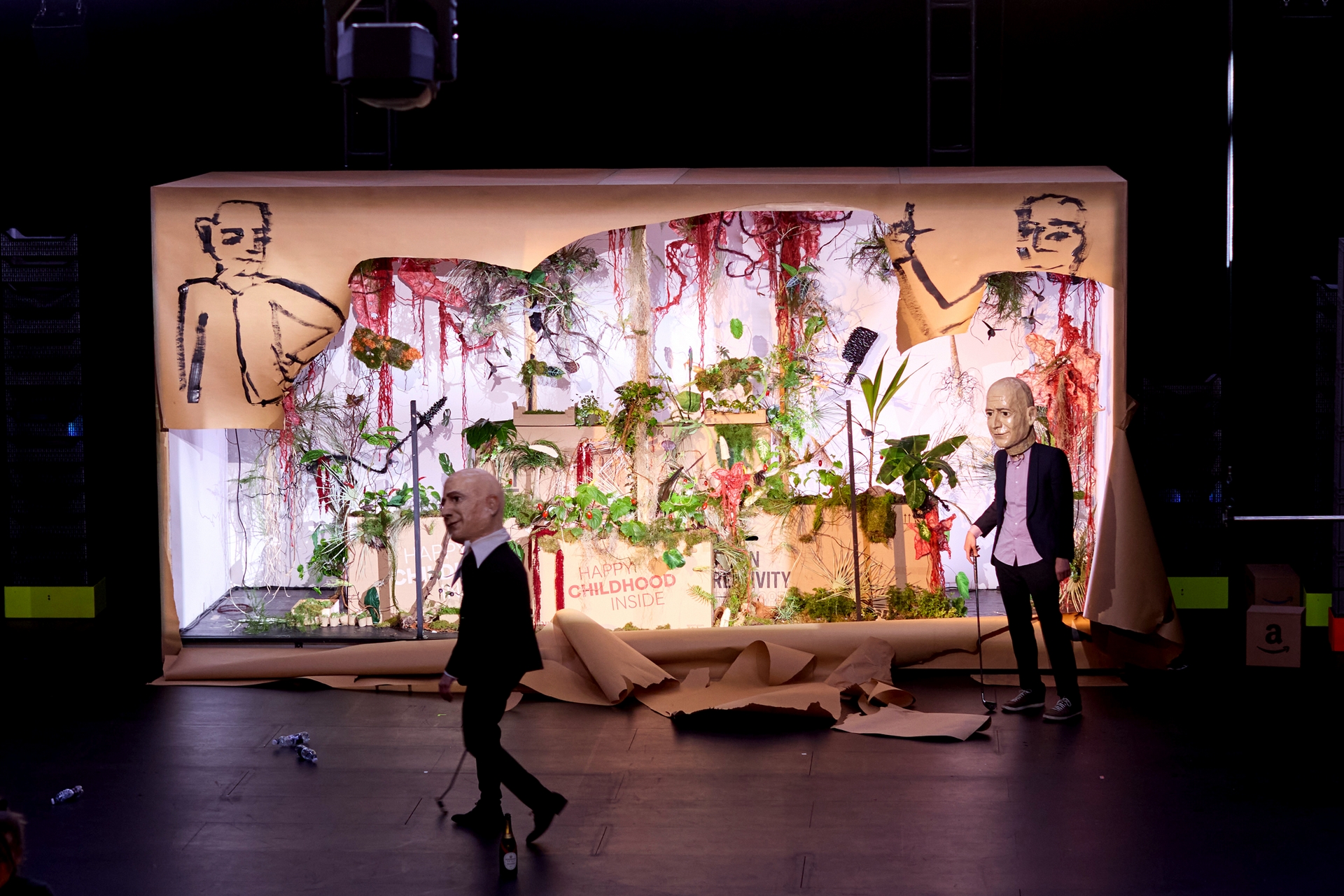
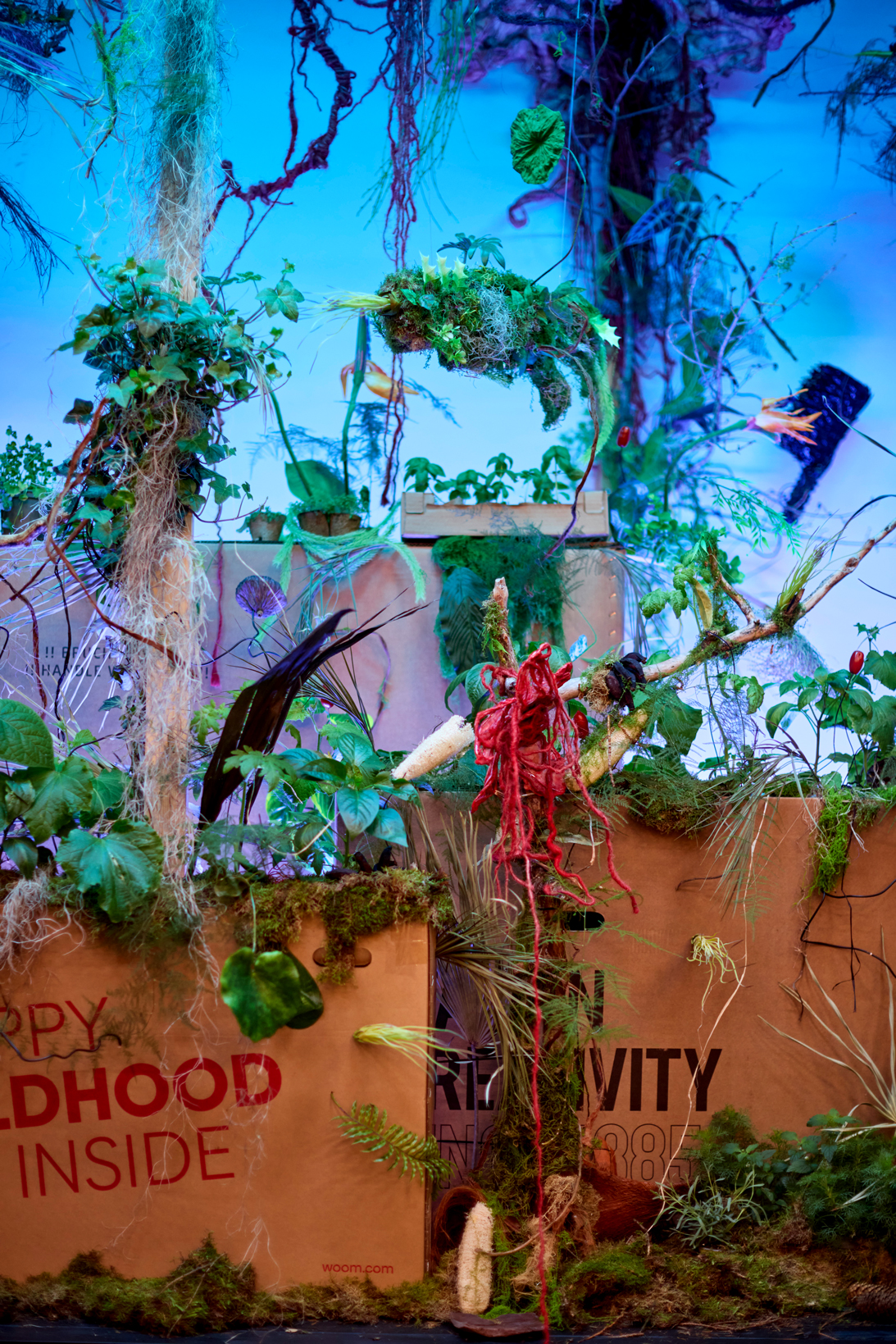
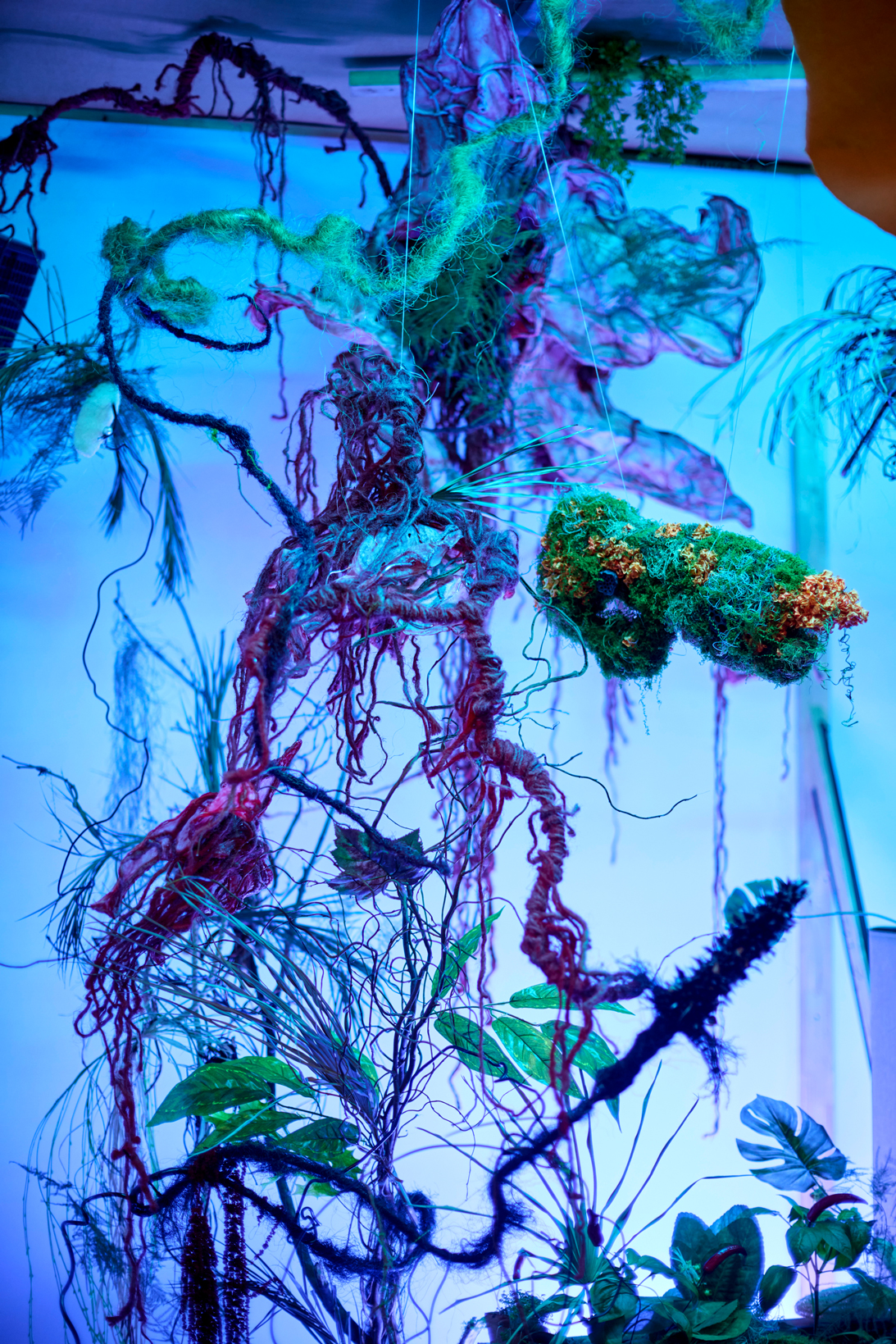
A personal highlight features a Bezos figure playing Konjuh planinom on the piano. Originating in the Yugoslav antifascist struggle of WWII, the song evokes a bond between partisans and nature, with the forest mourning their loss. By invoking this imagery, the performance connects past resistance to the present, questioning whether nature can still offer shelter or alliance—and answering bluntly: think again. The striking “ending” culminates in a tense stand-off between the audience and a giant terrarium, violently unpacked from the cardboard box by a blindfolded Bezos. Filled with plant-like weapons—or weapon-like plants—nature appears not as refuge, but as a threatening structure of our own making. In this confrontation, both audience and Bezoses face the consequences of what has been set in motion, underscored by a soundscape of helicopters, screams, and distant horror. It is as if nature screams—when it should have been us.
The stage falls silent as the only non-Bezos figure—a real, unmasked human—steps forward, as if to take the final bow. In that moment, he becomes the only one we can truly applaud. As a newly formed performance community, we seem to exclude Bezos from the only category system still available to us in this setting—that of the theatre audience. In a modest gesture, free of irony, the applause turns toward the human figure. Not as a celebration, but as a recognition: that it is the human who is both responsible for this system and the only one capable of changing it.
Jana Dolečki is an independent theatre scholar, co-artistic director of DAS WEISSE HAUS, program coordinator at Radio ORANGE 94.0, and conductor of the choir Hor 29. Novembar.
LINK